
イベント検索
405 件
-
ワークショップ
第19回 High Performance Computing Physics (HPC-Phys) 勉強会
2023年8月31日(木) 13:30 - 17:30
物理学の諸分野において計算科学によるアプローチは すでに欠かせない研究手法となっています。 一方で、大規模数値シミュレーションには、 計算機システムごとの最適化や 適切な計算手法の選択など、それ自体の技術的な難しさがあり、 分野を越えた研究者間の情報交換や協力体制が望まれます。 本研究会は、計算物理の広い範囲で情報交換を行なうことを目的とした活動を行っています。 第19回の研究会は、以下のようなプログラムで開催します。 プログラム (敬称略) 13:30-13:35 趣旨説明 13:35-14:25 白川 知功:「テンソルネットワーク法を用いた量子計算のシミュレーション」 14:25-15:15 小形 美沙:「ラグランジュ的定式化を用いた2次元の星の平衡形状の新たな計算法」 15:15-15:35 休憩 15:35-16:25 Rico Pohle:「Semi-classical Monte Carlo and molecular dynamics simulations of spin coherent states」 16:25-17:15 石川 健一:「Algorithms for Lattice Quantum Chromodynamics」 17:15-17:30 議論 (17:30- 現地にて簡単な懇親会)
会場: 理化学研究所 和光キャンパス 統合支援施設2階会議室
イベント公式言語: 日本語
-
セミナー
MNISQ: A Large-Scale Quantum Circuit Dataset for Machine Learning on/for Quantum Computers in the NISQ era
2023年8月29日(火) 14:00 - 15:30
Leonardo Placidi (大阪大学 大学院基礎工学研究科 博士課程)
We introduce the first large-scale dataset, MNISQ, for both the Quantum and the Classical Machine Learning community during the Noisy Intermediate-Scale Quantum era. MNISQ consists of 4,950,000 data points organized in 9 subdatasets. Building our dataset from the quantum encoding of classical information (e.g., MNIST dataset), we deliver a dataset in a dual form: in quantum form, as circuits, and in classical form, as quantum circuit descriptions (quantum programming language, QASM). In fact, also Machine Learning research related to quantum computers undertakes a dual challenge: enhancing machine learning by exploiting the power of quantum computers, while also leveraging state-of-the-art classical machine learning methodologies to help the advancement of quantum computing. Therefore, we perform circuit classification on our dataset, tackling the task with both quantum and classical models. In the quantum endeavor, we test our circuit dataset with Quantum Kernel methods, and we show excellent results with up to 97% accuracy. In the classical world, the underlying quantum mechanical structures within the quantum circuit data are not trivial. Nevertheless, we test our dataset on three classical models: Structured State Space sequence model (S4), Transformer, and LSTM. In particular, the S4 model applied on the tokenized QASM sequences reaches an impressive 77% accuracy. These findings illustrate that quantum circuit-related datasets are likely to be quantum advantageous, but also that state-of-the-art machine learning methodologies can competently classify and recognize quantum circuits. We finally entrust the quantum and classical machine learning community.
会場: 理化学研究所 和光キャンパス (メイン会場) / via Zoom
イベント公式言語: 英語
-
ワークショップ
Exploring 2D Quantum Spacetime Based on Causal Dynamical Triangulations
2023年8月21日(月) - 23日(水)
佐藤 勇貴 (徳山工業高等専門学校 准教授)
This is the fourth event by the Quantum Gravity Gatherings (QGG) Study Group at RIKEN iTHEMS. For this event we have invited Prof. Yuki Sato, National Institute of Technology, Tokuyama College, to give pedagogical lectures on the causal dynamical triangulations approach to quantum gravity. We wish this event to provide insights to researchers in related fields. The causal dynamical triangulations formalism appears to be one of the most promising constructive approaches to quantum gravity: possessing deep links with the asymptotic safety programme and Hořava-Lifshitz gravity, causal dynamical triangulations appears to avoid many of the well-known pathologies characteristic of its Euclidean analogue. As an example the emergence of spacetime geometry remains possible in various spacetime dimensions. While many of the results in higher dimensions are understood only at the numerical level, the analytical study of the approach in two spacetime dimensions is relatively well developed; Yuki Sato is a leading expert on these latter developments and we are very lucky he has agreed to present the understanding of 2D causal spacetime coming from this approach in a manner consistent with the Quantum Gravity Gatherings philosophy. This intensive lecture series is intended to be a lively and participatory event, not just a listening experience. For this reason, the number of participants will be limited to about 30 with priority given to graduate students and young post-docs; the intensive talk will be given in a face-to-face blackboard style (in English, no online streaming) to allow for informal and lively Q&A discussions. The program will also include short talk sessions, where interested participants can give a 5 min talk on a topic of their choice (their research, reviews on some works, what they want to study in the future, etc.). Registration is available via the dedicated website.
会場: 研究本館 4階 435-437号室
イベント公式言語: 英語
-
セミナー
Quasi-local holography in 3d quantum gravity
2023年8月4日(金) 14:00 - 15:30
Etera Livine (Research Director CNRS, Ecole Normale Supérieure de Lyon, France)
Since the idea appeared in black hole physics, the concept of holography has become a guiding principle for quantum gravity. It is the notion that the dynamics of the geometry of a region of space-time can be entirely encoded in a theory living on its boundary. Although such holographic dualities have been well-developed in an asymptotical context, it remains a challenge to realize it exactly at finite distances. I will draw a possible route in 3d quantum gravity, by showing a duality between the Ponzano-Regge path integral for 3d quantum gravity as a topological field theory and the 2d (inhomogeneous) Ising model. This leads to an intriguing geometrical interpretation of the Ising critical couplings and opens the door to a possibly rich interplay between 3d quantum gravity and 2d condensed matter built out of holographic dualities.
会場: セミナー室 (359号室) (メイン会場) / via Zoom
イベント公式言語: 英語
-
セミナー
Clifford Group and Unitary Designs under Symmetry
2023年7月31日(月) 14:00 - 15:30
三橋 洋亮 (東京大学 大学院工学系研究科 物理工学専攻 博士課程)
We have generalized the well-known statement that the Clifford group is a unitary 3-design into symmetric cases by extending the notion of unitary design. Concretely, we have proven that a symmetric Clifford group is a symmetric unitary 3-design if and only if the symmetry constraint is described by some Pauli subgroup. We have also found a complete and unique construction method of symmetric Clifford groups with simple quantum gates for Pauli symmetries. For the overall understanding, we have also considered physically relevant U(1) and SU(2) symmetry constraints, which cannot be described by a Pauli subgroup, and have proven that the symmetric Clifford group is a symmetric unitary 1-design but not a 2-design under those symmetries. Our findings are numerically verified by computing the frame potentials, which measure the difference in randomness between the uniform ensemble on the symmetric group of interest and the symmetric unitary group. This work will open a new perspective into quantum information processing such as randomized benchmarking, and give a deep understanding to many-body systems such as monitored random circuits.
会場: 理化学研究所 和光キャンパス 研究本館3階 345-347 (メイン会場) / via Zoom
イベント公式言語: 英語
-
講演会・レクチャー
3rd QGG Intensive Lectures: Spinfoam path integrals for Quantum Gravity
2023年7月26日(水) - 28日(金)
Etera Livine (Research Director CNRS, Ecole Normale Supérieure de Lyon, France)
At the crossroads of several approaches to quantum gravity, Spinfoams propose a discrete path integral for quantum general relativity built from topological field theory. With the spectrum of geometric operators directly read from the representation theory of the local symmetry group, they can be interpreted as a quantized version of Regge calculus and can be understood as implementing the dynamics of quantum states geometry in loop quantum gravity. I will explain the basics of the formalism, the motivations, the mathematical framework and the main tools. In three space-time dimensions, the spinfoam quantization of 3d gravity is given by the Turaev-Viro topological invariant, which is intimately related to the quantization of Chern-Simons theory. I will explain in particular how the spinfoam amplitudes solve the Wheeler-de Witt equation, implement the invariance under 3d diffeomorphisms (despite being formulated in a discretized space-time) and lead to a quasi-local version of holography. In four space-time dimensions, general relativity can be formulated as an almost-topological theory and I will explain how the existing spinfoam models introduce a sea of topological defects to re-create the gravitational degrees of freedom from a topological path integral. Finally, I will show how spinfoams are naturally defined in terms of group field theory, which are generalized tensor models, and the prospects that this opens. I will conclude with the main challenges and open lines of research of the field. Program: July 26 10:00 - 10:15 Registration and reception 10:15 - 11:45 Lecture 1 11:45 - 13:30 Lunch & coffee break 13:30 - 15:00 Lecture 2 15:00 - 16:00 Coffee break 16:00 - 17:00 Lecture 3 17:10 - 18:30 Short talk session July 27 10:00 - 11:45 Lecture 4 11:45 - 13:30 Lunch & coffee break 13:30 - 15:00 Lecture 5 15:00 - 16:00 Coffee break 16:00 - 17:00 Lecture 6 17:30 - 20:00 Banquet July 28 10:00 - 11:45 Lecture 7 11:45 - 13:30 Lunch & coffee break 13:30 - 15:00 Lecture 8 15:00 - 16:00 Coffee break 16:00 - 17:30 Lecture 9 & Closing
会場: 研究本館 4階 435-437号室
イベント公式言語: 英語
-
セミナー
Electronic instabilities emerging from higher-order van Hove singularities
2023年7月24日(月) 17:00 - 18:15
Xinloong Han (Postdoctoral Fellow, Kavli Institute for Theoretical Sciences, University of Chinese Academy of Sciences, China)
Time: 5pm ~ 6:15pm (JST); 10am ~ 11:15am (CET); 4pm ~ 5:15pm (Taiwan) Field: condensed matter physics Keywords: topological superconductor, Van Hove singularity, Hubbard model, Kagome lattices Abstract: Competing correlated electronic states are a central topic in condensed matter physics. A typical example is the close competition between spin density wave and d-wave superconductivity in the Hubbard model on the square lattice near half filling where the band structures have saddle points at which the Fermi surface topology changes from hole type to electron type. The saddle points are called van Hove singularity (VHS) points, and host diverging density of states with power-law behavior in the two dimensions. Recently, another type of VHS, namely the higher-order VHS was investigated in ABC-stacked trilayer graphene and twisted bilayer graphene. In this talk, I will first introduce the higher-order VHS, and make comparisons to the conventional VHS. Then I will discuss the enhanced nematicity driven by large flavor number with higher-order VHSs on the square and Kagome lattices. Finally, I will show that robust topological superconductivity can emerge on the square lattice due to interplay of spin-orbital coupling and higher-order VHSs.
会場: コモンルーム 246-248号室 とZoomのハイブリッド開催
イベント公式言語: 英語
-
セミナー
Conserved charges in the quantum simulation of integrable spin chains
2023年7月12日(水) 13:30 - 15:00
Juan William Pedersen (東京大学 大学院総合文化研究科 博士課程)
In this talk, we present the result of the quantum simulation of the spin-1/2 Heisenberg XXX spin chain. We implement the integrable Trotterization algorithm, which allows us to control the Trotter error with conserved charges remaining conserved, on a real quantum computer and classical simulators. We study the effects of quantum noise on the time evolution of several conserved charges and specifically observe the decay of the expectation values. Our work improves our understanding of quantum noises and can potentially be applied to benchmark quantum devices and algorithms.
会場: セミナー室 (359号室) (メイン会場) / via Zoom
イベント公式言語: 英語
-
講演会・レクチャー

NU-Q-iTHEMS-YITPレクチャー:量⼦計算の場の量⼦論への応⽤
2023年7月6日(木) - 7日(金)
本多 正純 (京都大学 基礎物理学研究所 助教)
量子計算の場の量子論の数値シミュレーションへの応用について、入門的な解説を行う。まず量子計算の基礎的な部分を解説した後に、量子計算のスピン系のシミュレーションへの応用について議論する。その後連続的場の量子論・および格子上の場の量子論に関する入門的な解説を行い、場の量子論のシミュレーションについて議論する。また、IBM qiskitを用いた量子シミュレーションの実習も行う。 実習参加者への注意: 実習に使うノートPCの貸出はないので、ご持参するようお願いします。 予めAnacondaなどを導入するなどして、Jupyter Notebookを使えるように環境を整えておくようお願いいたします。 主催:新潟⼤学量⼦研究センター (NU-Q)、 京都⼤学基礎物理学研究所 (YITP) 共催:理化学研究所 数理創造プログラム (iTHEMS)
会場: 新潟大学 理学部A棟 A317号室(大会議室) / via Zoom
イベント公式言語: 日本語
-
セミナー
The classical equations of motion of quantised gauge theories
2023年6月23日(金) 13:30 - 15:00
トム・メリア (東京大学 カブリ数物連携宇宙研究機構 (Kavli IPMU) 准教授)
The Einstein and Maxwell equations are the jewels in the crown of classical physics. But classical physics is only an approximation to nature, arising as a limit of the underlying quantum mechanical description. And in the case of both general relativity and electromagnetism, owing to their gauge theory nature, the full set of classical equations of motion are not guaranteed to follow from the quantum theory. The time-time and time-space components of the Einstein equations in GR and Gauss’ law in EM are enforced ‘by hand' in the quantisation procedure—a choice so as to make the classical-like states behave as per our classical belief. But what if our universe was actually described by another classical-like state? For GR, the resulting modification of the Einstein equations can be packaged as the inclusion of an auxiliary energy-momentum tensor describing a ’shadow’ matter that adds no additional degrees of freedom to the theory. The homogeneous and isotropic background piece of this auxiliary matter contributes to expansion of the universe identical to cold dark matter, and the inhomogeneous components source curvature perturbations that grow linearly at linear order.
会場: 研究本館 3階 359号室とZoomのハイブリッド開催
イベント公式言語: 英語
-
セミナー
Quantum skyrmion lattices in Heisenberg ferromagnets
2023年6月8日(木) 17:00 - 18:15
Andreas Haller (Postdoctoral Researcher, Department of Physics and Materials Science, University of Luxembourg, Luxembourg)
Skyrmions are topological magnetic textures that can arise in noncentrosymmetric ferromagnetic materials. In most systems experimentally investigated to date, skyrmions emerge as classical objects. However, the discovery of skyrmions with nanometer length scales has sparked interest in their quantum properties. In this talk, I present our (numeric) results on the ground states of unfrustrated two-dimensional spin-1/2 Heisenberg lattices with Dzyaloshinskii-Moriya interactions, where we discovered a broad region in the zero-temperature phase diagram which hosts quantum skyrmion lattices. The simulations are based on an established variational optimization algorithm for matrix product states called density matrix renormalization group, which can faithfully approximate the ground states of small 2D clusters well beyond system sizes amenable for exact diagonalization. We argue that the quantum skyrmion lattice phase can be detected experimentally in the magnetization profile via local magnetic polarization measurements as well as in the spin structure factor via neutron scattering experiments. Deep in the skyrmion ordered phase, we find that the quantum skyrmion lattice state is only weakly entangled with ‘domain wall' entanglement between quasiparticles and environment localized near the boundary spins of the skyrmion. In this ordered regime of weakly entangled entities, large clusters of O(1000) sites can be simulated with great efficiency. Field: condensed matter physics Keywords: quantum spin systems, topology, density matrix renormalization group
会場: via Zoom
イベント公式言語: 英語
-
セミナー
Around homogeneous spaces of complex semisimple quantum groups
2023年6月7日(水) 14:00 - 16:30
北村 侃 (東京大学 大学院数理科学研究科 博士課程)
Murray and von Neumann initiated the study of operator algebras motivated by the mathematical foundations of quantum physics. Operator algebras give good language to treat quantum symmetries, such as quantum groups. In this talk, I would like to give an overview of this topic first. Then, I discuss the q-deformations of complex semisimple Lie groups. From an operator algebraic viewpoint, we can treat them as "locally compact" quantum groups. Especially, I will focus on its homogenous spaces coming from discrete quantum subgroups with a motivation toward the quantum analog of lattices. Unlike the classical setting, we can obtain a complete classification of its discrete quantum subgroups.
会場: セミナー室 (359号室) (メイン会場) / via Zoom
イベント公式言語: 英語
-
セミナー
Quantum uncertainty of fields and its effect on entanglement generation in quantum particles
2023年5月31日(水) 14:00 - 15:15
杉山 祐紀 (九州大学 大学院理学府 物理学専攻 博士課程)
The unification of gravity and quantum mechanics is one of the important problems. To elucidate the theory of quantum gravity, it is becoming more and more important to get any hint of the quantum nature of gravity. In particular, the quantum-gravity-induced-entanglement of masses (QGEM) scenario, which is expected to observe the quantum nature of non-relativistic gravity, has recently attracted great attention. In this talk, we show the effect of relativistic fields on entanglement generation based on quantum field theory. We also discuss the relationship between the entanglement generation and quantum uncertainty of the fields.
会場: セミナー室 (359号室) / via Zoom
イベント公式言語: 英語
-
セミナー

Spectral correlations and scrambling dynamics in Sachdev-Ye-Kitaev type models
2023年5月30日(火) 13:30 - 15:00
手塚 真樹 (京都大学 大学院理学研究科 物理学・宇宙物理学専攻 助教)
Note: Due to unexpected trouble, we have made the decision to postpone the seminar scheduled for February 21 to May 30. Sorry for the trouble. Abstract: The Sachdev-Ye-Kitaev (SYK) model, proposed in 2015, is a quantum mechanical model of N Majorana or complex fermions with all-to-all random four-body interactions. The model has attracted significant attention over the years due to its features such as the existence of the large-N solution with maximally chaotic behavior at low temperatures and holographic correspondence to low-dimensional gravity. The sparse version of the SYK model reproduces essential features of the original model for reduced numbers of disorder parameters. We recently proposed [1] a further simplification, where we set the nonzero couplings to be +1 or -1 rather than sampling from a continuous distribution such as Gaussian. This binary-coupling model exhibits strong correlations in the spectrum, as observed in the spectral form factor, more efficiently in terms of the number of nonzero terms than in the Gaussian distribution case. We also discuss the scrambling dynamics with the binary-coupling sparse SYK model, comparing the model with the original model as well as the SYK model with random two-body terms [2], where the localization of the many-body eigenstates in the Fock space has been quantitatively studied [3,4].
会場: 研究本館 3階 359号室とZoomのハイブリッド開催
イベント公式言語: 英語
-
セミナー
Excursion Theory, Galton Watson Trees and their Scaling Limits
2023年5月18日(木) 16:00 - 17:00
クリスティ・コウジ・ケリー (理化学研究所 数理創造プログラム (iTHEMS) 基礎科学特別研究員)
In this talk we aim to introduce a recent perspective in probability theory that views random trees as random excursions with additional data. This perspective is particular suited to the study of the scaling limit of tree-valued random processes. Excursion theory is a useful and relatively elementary tool allowing one to derive rather explicit information about the local and global geometry of the resultant continuum trees which in turn can be used to derive information about large random trees. We illustrate these ideas in the context of the Brownian continuum random tree, the scaling limit of critical Galton-Watson trees and a structure that arises naturally in various contexts in physics; in particular the Brownian continuum random tree is a pathological model of quantum spacetime. Despite the fundamentally mathematical nature of the talk, the aim is to keep the presentation essentially heuristic emphasising key intuitions over rigorous proof. The content itself should be relevant to biologists interested in the theory of branching processes or coalescent theory.
会場: セミナー室 (359号室) / via Zoom
イベント公式言語: 英語
-
セミナー
Ground-state phases of the one-dimensional SU(N)-symmetric Kondo lattice model
2023年5月11日(木) 17:00 - 18:15
戸塚 圭介 (京都大学 基礎物理学研究所 准教授)
The Kondo-lattice model and its variants (e.g., the Kondo-Heisenberg model), in which itinerant fermions interact with immobile magnetic moments via spin-exchange coupling (Kondo coupling), have been playing an important role in understanding the physics of heavy-fermion systems. In this talk, I begin by quickly explaining how the SU(N) Kondo-lattice model, in which the spin SU(2) symmetry is generalized to SU(N), is realized in actual physical systems (e.g., cold fermions and twisted bilayer graphene), and then I focus on the ground-state properties of its one-dimensional version. Specifically, when the Kondo coupling is sufficiently large, we find ferromagnetic metallic phases that can be established rigorously as well as several insulating ones. I also show that the SU(N) Kondo-lattice model provides a natural condensed-matter realization of supersymmetric [i.e., SU(N|1)] models. Various (insulating) phases at small Kondo coupling are then explored using the machinery of bosonization and various conformal field theory (CFT) techniques, and the results are compared with the predictions of the Lieb-Schultz-Mattis-type (or anomaly-matching) argument. Field: condensed matter physics Keywords: Kondo lattice model, SU(N) symmetry, supersymmetry, heavy-fermion systems, bosonization, conformal field theory
会場: via Webex
イベント公式言語: 英語
-
セミナー
Quantum transport with cold atoms
2023年5月10日(水) 13:30 - 15:00
内野 瞬 (日本原子力研究開発機構 先端基礎科学センター 研究員)
Quantum transport occurring through a mesoscopic conduction region allows us to extract interesting quantum many-body phenomena. For decades, solid-state systems have been the playground of such transport and revealed nontrivial outcomes such as the conductance quantization in a quantum point contact system and the fractional charge measurement in a fractional quantum Hall system. More recently, cold atoms trapped in the vacuum have served as the complementary system to study the quantum transport phenomena. In this seminar, I wish to discuss the recent progresses of quantum transport with cold atoms. The great advantages of those systems are that one can control quantum statistics, inter-particle interactions, dissipation, and dimensions. I try to show that such controllability enables to explore a regime of quantum transport that has yet to be reached with solid-state materials, including transport of bosons, dissipation effect in transport, and transport with synthetic dimensions.
会場: セミナー室 (359号室) (メイン会場) / via Zoom
イベント公式言語: 英語
-
ワークショップ
Spring Workshop on Quantum Gravity
2023年4月26日(水) - 28日(金)
This is co-hosted by iTHEMS and NCTS, and is also the first of Quantum Gravity Gatherings. What is space-time? How did the universe begin? Various approaches exist toward theories of quantum gravity that can answer such fundamental questions. Each approach has its own strengths and weaknesses and should capture, at least partially, some essential aspect of quantum gravity. Then, what are the general properties (if any) of the quantum nature of gravity independent of the details of such approaches? As the main speaker, we have asked Hikaru Kawai to give an intensive talk approaching this question from both general and specific arguments in a style consistent with the concept of Quantum Gravity Gatherings. We hope that the younger generation will experience his powerful arguments based on his experience and deep insights. This workshop is intended to be a lively and participatory event, not just a listening experience. For this reason, the number of participants will be limited to about 30 with priority given to graduate students and young post-docs; the intensive talk will be given in a face-to-face blackboard style (in English, no online streaming) to allow for informal and lively Q&A discussions. In addition, there will be sessions where any participant can give a short talk on any topic of his/her choice. Through these, all the participants will discuss the above question from various angles, and the young generations in Japan and Taiwan will stimulate each other and start new exchanges.
会場: 研究本館 4階 435-437号室
イベント公式言語: 英語
-
コロキウム
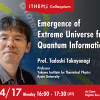
Emergence of Extreme Universe from Quantum Information
2023年4月17日(月) 16:00 - 17:30
高柳 匡 (京都大学 基礎物理学研究所 教授)
Recently, a new interpretation of gravitational spacetime in terms of quantum entanglement has been obtained. The idea of holography in string theory provides a simple geometric computation of entanglement entropy. This generalizes the well-known Bekenstein-Hawking formula of black hole entropy and strongly suggests that a gravitational spacetime consists of many qubits with quantum entanglement. Also a new progress on black hole information problem has been made recently by applying this idea. I will explain these developments in this colloquium.
会場: via Zoom
イベント公式言語: 英語
-
セミナー

Quantum modularity of quantum invariants and related techniques
2023年4月11日(火) 13:00 - 15:30
村上 友哉 (九州大学 数理学研究院 日本学術振興会 特別研究員 PD)
In this talk, I will present my recent work[1] and related research. In the first half of the talk, I will provide an overview of the concept of quantum modularity of quantum invariants, and briefly discuss my main result. In the second half, I will provide a more detailed explanation of my main result and the proof.
会場: セミナー室 (359号室) (メイン会場) / via Zoom
イベント公式言語: 英語