
コロキウム
73 イベント
-
 コロキウム
コロキウムMACSスタディグループ活動紹介・交流会
2026年11月13日(金) 14:45 - 18:30
14:45-15:00 ティータイムディスカッション 15:00-17:30 MACSスタディグループ活動紹介・交流会(各スタディグループのブースにて) 17:30-18:30 継続討論会
会場: 京都大学 理学研究科セミナーハウス(建物配置図(北部構内)【10】の建物)
イベント公式言語: 日本語
-
コロキウム

Efficient iBF: Balanced Integration of Fragmented Matching Markets for Welfare Improvement
2026年9月4日(金) 15:30 - 17:00
小島 武仁 (東京大学 経済学研究科 教授)
Matching markets often suffer from fragmentation, which leads to inefficiency. We model a fragmented market in a school-choice context and offer a practically relevant method for integration. Specifically, each student and school belong to a region, and we allow for inter-regional transfer of students with "balancedness" constraint: a matching is said to be balanced if, for each region, the outflow of students from that region to other regions is equal to the inflow of students from the latter to the former. Using a directed bipartite graph defined on students and schools, we characterize the set of Pareto efficient matchings among those that are individually rational, balanced and fair (efficient iBF). We also provide a class of polynomial-time algorithms to compute such matchings. When each region favors local students in their priority, the outcome of an algorithm from this class weakly improves student welfare upon the outcome where each region independently uses the deferred acceptance mechanism. Various real-life examples of fragmentation are discussed, and we illustrate how our method would address the issue.
会場: 大河内記念ホール (メイン会場) / via Zoom
イベント公式言語: 英語
-
コロキウム

Hidden Networks: From Phase Reductions to Effective Network Interactions
2026年8月24日(月) 15:30 - 17:00
Christian Bick (Associate Professor, Department of Mathematics, Vrije Universiteit Amsterdam, Netherlands)
From networks of interconnected neurons in the brain to coupled electrochemical reactions: The collective dynamics of interacting dynamical systems shape the function (or dysfunction) of many systems that are critical for our everyday lives. For coupled oscillatory processes, synchronization is a prime example of emergent collective dynamics. But how oscillators interact is not necessarily obvious from (physical) connections between the oscillators. Here we look at phase reductions as a way to uncover the hidden 'effective' network interactions for coupled oscillators dynamics. On the one hand, these give insight into when oscillators do and do not interact (despite a link). On the other hand, they elucidate when and how nonpairwise higher-order interactions shape synchronization phenomena in coupled oscillator networks.
会場: 大河内記念ホール (メイン会場) / via Zoom
イベント公式言語: 英語
-
コロキウム

第33回 MACSコロキウム
2026年7月17日(金) 14:45 - 18:00
成瀬 元 (京都大学 大学院理学研究科 地球惑星科学専攻 教授)
村瀬 洋介 (理化学研究所 数理創造研究センター (iTHEMS) 数理展開部門 数理社会科学チーム チームディレクター)14:45-15:00 ティータイムディスカッション 15:00-16:00 成瀬 元(京都大学大学院理学研究科 地球惑星科学専攻 教授)「地層は何を覚えているのか?―機械学習で探る過去の地球環境―」 16:15-17:15 村瀬 洋介(理化学研究所 数理創造研究センター チームディレクター)「社会における協力行動の数理:直接互恵と間接互恵から見る協力の進化」 17:15-18:00 継続討論会
会場: 京都大学 理学研究科セミナーハウス(建物配置図(北部構内)【10】の建物)
イベント公式言語: 日本語
-
コロキウム

How did we come to be? — Particle Physics for the Next Decades —
2026年7月10日(金) 15:30 - 17:00
村山 斉 (東京大学 カブリ数物連携宇宙研究機構 (Kavli IPMU) 教授 / Professor, Department of Physics, University of California, Berkeley, USA)
Particle Physics is a study of the smallest and the biggest to uncover the fundamental laws that govern the universe. In recent years, both the United States and Europe have been through long-range planning processes. The future plans worldwide include the studies of (1) neutrinos that may have saved us from a complete annihilation, (2) the Higgs boson that keeps us in one piece, (3) dark matter that assembled us from the primordial soup, (4) inflation that created the macroscopic universe, and (5) the exploration of unknown particles and forces. It requires development of mind-boggling technologies.
会場: 大河内記念ホール (メイン会場) / via Zoom
イベント公式言語: 英語
-
コロキウム

第32回 MACSコロキウム・2026年度MACS学生説明会
2026年4月17日(金) 14:45 - 18:30
冨田 夏希 (京都大学 大学院理学研究科 附属サイエンス連携探索センター (SACRA) 准教授)
14:45-15:00 ティータイムディスカッション 15:00-16:00 冨田 夏希(京都大学大学院理学研究科附属サイエンス連携探索センター 准教授)「質量の起源を探る」 16:15-17:20 2026年度MACS学生説明会 17:30-18:30 継続討論会
会場: 京都大学 理学研究科セミナーハウス(建物配置図(北部構内)【10】の建物)
イベント公式言語: 日本語
-
コロキウム

第31回 MACSコロキウム・2025年度MACS成果報告会
2026年2月18日(水) 14:45 - 18:00
衞藤 雄二郎 (京都大学 大学院理学研究科 附属サイエンス連携探索センター (SACRA) 准教授)
14:45-15:00 ティータイムディスカッション [15:00-16:00 第31回MACSコロキウム 講演] 衞藤 雄二郎(京都大学大学院理学研究科 附属サイエンス連携探索センター 准教授)「明るい量子光源を使った量子計測」 [16:10-18:30 2025年度MACS成果報告会] 16:10-17:10 各スタディグルーブ フラッシュトーク 17:10-18:00 参加学生によるポスター発表
会場: 京都大学 理学研究科 6号館401号室(建物配置図(北部構内)【4】の建物)
イベント公式言語: 日本語
-
コロキウム

Measuring evolutionary forces of cultural change
2026年1月13日(火) 14:00 - 15:30
ジョシュア・プロトキン (Walter H. and Leonore C. Annenberg Professor of the Natural Sciences, University of Pennsylvania, USA)
I will describe how to measure the forces that drive cultural change, using inference tools from evolutionary theory. We study time series data from large corpora of parsed English texts to identify what drives language change over the course of centuries. We also measure frequency-dependent effects in time series of baby names and purebred dog preferences. The form of frequency dependence we infer helps to explain the diversity distribution of names, and it replicates across the United States, France, Norway and the Netherlands. We find different growth laws for male versus female names, attributable to different rates of innovation, whereas names from the bible enjoy a genuine advantage at all frequencies. Frequency dependence emerges from a host of underlying social and cultural mechanisms, including a preference for novelty that recapitulates fashion trends in dog owners. Studying culture through the lens of evolutionary theory provides a quantitative account of social pressures to conform or to be different; and it provides inference tools that may be used in biology as genetic and phenotypic time series are increasingly available.
会場: 大河内記念ホール (メイン会場) / via Zoom
イベント公式言語: 英語
-
コロキウム

第30回 MACSコロキウム
2025年11月28日(金) 14:45 - 18:00
石川 勲 (京都大学 大学院理学研究科 附属サイエンス連携探索センター (SACRA) 特定准教授)
黒谷 賢一 (京都大学 大学院理学研究科 附属サイエンス連携探索センター (SACRA) 准教授)14:45-15:00 ティータイムディスカッション 15:00-16:00 石川 勲(京都大学大学院理学研究科 附属サイエンス連携探索センター 特定准教授)「関数空間で読み解く力学系のデータ駆動解析」 16:15-17:15 黒谷 賢一(京都大学大学院理学研究科 附属サイエンス連携探索センター 准教授)「植物科学とデータ科学の融合」 17:15-18:00 継続討論会
会場: 京都大学 理学研究科セミナーハウス(建物配置図(北部構内)【10】の建物)
イベント公式言語: 日本語
-
コロキウム

Why do we sleep? — The Role of Calcium and Phosphorylation in Sleep
2025年10月10日(金) 15:30 - 17:00
上田 泰己 (東京大学 大学院医学系研究科 システムズ薬理学教室 教授 / 久留米大学 分子生命科学研究所 個体システム生物学研究部門 教授)
Sleep remains one of greatest remaining mysteries. At the Sleep 2012 conference, we conceived a shift from the concept of “sleep substances” to “wake substances” such as calcium, suggesting that sleep homeostasis may arise from the integration of wake-related activity. Inspired by Dr. Setsuro Ebashi’s work on calcium signaling, we investigated calcium’s role in sleep regulation. Using our Triple-CRISPR method (Sunagawa et al. 2016), we screened 25 genes related to calcium channels and pumps, revealing calcium as a brake on brain activity to promote sleep (Tatsuki et al. 2016). We also developed a tissue-clearing method CUBIC (Susaki et al. 2014; Tainaka et al. 2014) to visualize calcium’s effects on neural circuits. Further work showed that calcium-dependent enzymes, CaMKIIα/β kinases, act as calcium “memory” devices, with phosphorylation sites controlling sleep onset, duration, and termination (Tone et al. 2022). Other direct and indirect calcium-dependent phosphatases, Calcineurin and PP1 (sleep-promoting), and opposing kinases, PKA (wake-promoting), function as synaptic sleep switches (Wang et al. 2024). We also identified the ryanodine receptor 1, a calcium channel, as a molecular target of inhalational anesthetics, hinting at shared pathways between anesthesia and sleep (Kanaya et al. 2025). Lastly, we proposed the WISE (Wake Inhibition Sleep Enhancement) mechanism, where quiet wakefulness suppresses and deep sleep strengthens synaptic connections, explaining links between sleep, depression, and antidepressant effects (Kinoshita et al. 2025).
会場: 大河内記念ホール (メイン会場) / via Zoom
イベント公式言語: 英語
-
コロキウム

Chemical and isotopic analyses of samples returned by the Hayabusa2 mission from the asteroid Ryugu
2025年8月1日(金) 14:00 - 15:30
横山 哲也 (東京科学大学 理学院 地球惑星科学系 教授)
The recent success of asteroid sample return missions has led to significant advances in Solar System science. JAXA's Hayabusa2 successfully retrieved and returned to Earth a total of 5.4 grams of samples from the C-type asteroid Ryugu. Sample return missions are critical to the scientific community, as they provide pristine, terrestrially unaltered extraterrestrial material. The analytical data obtained in laboratories for samples collected by space missions will facilitate the understanding of the formation and evolution of the Solar System. I was appointed deputy leader of the Initial Analysis Chemistry team of Hayabusa2 project, and was heavily involved in analyzing the chemical and isotopic compositions of Ryugu materials. A series of analyses of these samples indicated that the mineral, chemical, and isotopic compositions of Ryugu bear a strong resemblance to those of the Ivuna-type (CI) carbonaceous chondrites. CI chondrites have been recognized as a unique group of meteorites with a chemical composition similar to that of the solar photosphere except for highly volatile elements and Li. In the seminar, I will present the meaning and significance of the compositional similarity between Ryugu and CI chondrites. I will also present our recent activities in a new project called the Ryugu Reference Project, which was initiated to maximize the potential value of the returned samples.
会場: 理化学研究所和光キャンパス 本部棟2階大会議室 (メイン会場) / via Zoom
イベント公式言語: 英語
-
コロキウム

第29回 MACSコロキウム
2025年7月4日(金) 14:45 - 18:00
坂上 貴之 (京都大学 大学院理学研究科 数学・数理解析専攻 教授)
佐々 真一 (京都大学 大学院理学研究科 物理学・宇宙物理学専攻 教授)14:45-15:00 ティータイムディスカッション 15:00-16:00 坂上 貴之(京都大学大学院理学研究科 数学・数理解析専攻 教授)「流線トポロジカルデータ解析・応用と展望 ~「うつろうかたち」の数理モデリング~」 16:15-17:15 佐々 真一(京都大学大学院理学研究科 物理学・宇宙物理学専攻 教授)「時間の矢の物理学」 17:15-18:00 継続討論会
会場: 京都大学 理学研究科セミナーハウス(建物配置図(北部構内)【10】の建物)
イベント公式言語: 日本語
-
コロキウム

第28回 MACSコロキウム・2025年度MACS学生説明会
2025年4月25日(金) 14:45 - 18:30
鍛冶 静雄 (九州大学 マス・フォア・インダストリ研究所 教授 / 京都大学 大学院理学研究科 附属サイエンス連携探索センター (SACRA) 教授)
14:45-15:00 ティータイムディスカッション 15:00-16:00 鍛冶 静雄(九州大学マス・フォア・インダストリ研究所 教授/京都大学理学研究科附属サイエンス連携探索センター 教授)「折り紙にひそむ数学:カライドサイクルの幾何学」 16:15-17:20 2024年度MACS学生説明会 17:30-18:30 継続討論会
会場: 京都大学 理学研究科セミナーハウス(建物配置図(北部構内)【10】の建物)
イベント公式言語: 日本語
-
コロキウム

Smart heuristics of a single-celled organism
2025年3月7日(金) 14:00 - 15:30
中垣 俊之 (北海道大学 電子科学研究所 教授)
Although we rarely question how smart unicellular organisms are, it has become clear that unicellular organisms are smarter than we expected. In fact, various protozoa (unicellular eukaryotes) can take actions that are advantageous for their survival even in complex environments in the wild environments. In this talk, I will introduce some typical examples of smart behaviors in a protozoan amoeba (the plasmodium of Physarum polycephalum): (1) maze-solving, (2) formation of multi-functional transport network that mimics public transportation network among cities in Tokyo region, and so on. We will propose a mathematical model of these behaviors and extract the heuristics (simple rules of behavior) that give rise to their smartness. In general, we will discuss the future potential of research into the behavioral intelligence of protozoa.
会場: 大河内記念ホール (メイン会場) / via Zoom
イベント公式言語: 英語
-
コロキウム

MACS10周年記念コロキウム・2024年度MACS成果報告会
2025年2月19日(水) 14:45 - 18:30
國府 寛司 (京都大学 理事)
高橋 淑子 (京都大学 大学院理学研究科 生物科学専攻 教授)14:45-15:00 ティータイムディスカッション [15:00-16:30 第1部 MACS10周年記念コロキウム] 15:05-15:05 はじめに(佐々真一 SACRA学際融合部門長) 15:05-15:30 講演1「MACS はどのように始まったか?」國府寛司 博士 (数学・数理解析専攻 教授) 2016年5月のキックオフシンポジウムから始まったMACSが2025年度で10年目を迎えるという時期にあたり,その立ち上げの時のことを振り返ってお話したい.特に,10年前にどのような人々がどのようなことを考えて,それがMACSプログラムに至ったのか,また当初MACSでやりたいと思っていたができなかったことなどを思い出し,この10年のMACSの歩みや,MACSとその後の京大理学の諸活動との関わりなどについて,いくつか取り上げてお話してみたい. 15:30-15:55 講演2「MACSから生まれた躍動感」高橋淑子 博士 (生物科学専攻 教授) 「MACS」は語呂がよかったせいか多くの人に覚えていただき、「名付け親」として嬉しい限りです。私はベタベタの実験発生生物学者であり数学とは縁遠かったのですが、なぜかMACSには初めから首を突っ込む形となり、以来、10年間にわたりSGを企画しました。「本物(トリ胚)をみて数理を考える」という共通テーマのもと、物理・数学の院生や学部生たちが数式を議論し、顕微鏡をのぞいて生(なま)のトリ胚を観る姿に心躍りました。当時ハーバード大から出た「腸ルーピング」論文は、実験生物―物理―数理の融合研究で世の中を驚愕させましたが、「ハーバードでできることが京大理学でできないはずがない」を合い言葉に、新しい挑戦に胸躍る10年間でした。 15:55-16:20 質疑応答 16:20-16:30 休憩 [16:30-18:30 第2部 2024年度 MACS 成果報告会] 16:30-17:30 各スタディグルーブ フラッシュトーク 17:30-18:30 参加学生によるポスター発表
会場: 京都大学 理学研究科セミナーハウス(建物配置図(北部構内)【10】の建物)
イベント公式言語: 日本語
-
コロキウム

第27回 MACSコロキウム
2024年11月25日(月) 14:45 - 18:00
濱崎 立資 (理化学研究所 開拓研究本部 (CPR) 濱崎非平衡量子統計力学理研白眉研究チーム 理研白眉研究チームリーダー)
榎戸 輝揚 (京都大学 大学院理学研究科 物理学・宇宙物理学専攻 物理学第二教室 准教授)14:45-15:00 ティータイムディスカッション 15:00-16:00濱崎 立資 博士(理化学研究所 開拓研究本部 非平衡量子統計力学理研白眉研究チーム 理研白眉チームリーダー)「量子力学による統計力学の基礎づけ」 16:15-17:15 榎戸 輝揚 博士(京都大学理学研究科 物理学・宇宙物理学専攻 物理学第2教室 准教授)「学際融合で進める宇宙時代のシスルナ科学へ」 17:15-18:00 継続討論会
会場: 京都大学 北部総合教育研究棟 1階 益川ホール
イベント公式言語: 日本語
-
コロキウム
第26回 MACSコロキウム
2024年7月8日(月) 14:45 - 18:00
田口 聡 (京都大学 大学院理学研究科 地球惑星科学専攻 教授)
野田口 理孝 (京都大学 大学院理学研究科 生物科学専攻 教授)14:45-15:00 ティータイムディスカッション 15:00-16:00 田口 聡 博士(京都大学理学研究科地球惑星科学専攻 教授 / 附属サイエンス連携探索セン ター センター長)「太陽風が奥深く入ってくる場所での地球の大気とプラズマの振る舞い」 16:15-17:15 野田口 理孝 博士(京都大学大学院理学研究科生物科学専攻植物学系 教授)「植物科学のために挑んだ学際融合」 17:15-18:00 継続討論会
会場: 京都大学 理学研究科セミナーハウス(建物配置図(北部構内)【10】の建物)
イベント公式言語: 日本語
-
コロキウム

The New World of Spin Zero - Some Novel Approaches at QUP for Experimental Particle Cosmology -
2024年5月28日(火) 13:30 - 15:00
羽澄 昌史 (高エネルギー加速器研究機構 (KEK) 量子場計測システム国際拠点(QUP) 拠点長)
Particle cosmology is a discipline seeking a fundamental understanding of the Universe based on particle physics. Five mysteries drive our research today: cosmic inflation, baryon asymmetry, neutrino properties, dark matter, and dark energy. Resolving any of the five mysteries will revolutionize our picture of the Universe. Numerous interesting theoretical hypotheses have been proposed to this end. Many require new scalar quantum fields, such as inflatons, axions, supersymmetric particles, etc. They are, in a sense, an attempt to expand the role of the vacuum. Since we have not found such spin-zero fields yet, we shall invent new eyes to make an experimental or observational breakthrough. The International Center for Quantum-field Measurement Systems for Studies of the Universe and Particles (QUP) was established in December 2021 at KEK under the WPI program of MEXT and JSPS. With its tagline of "bring new eyes to humanity," one of the primary missions of QUP is inventing and developing such new eyes for particle cosmology. In this seminar, after briefly introducing QUP, I focus on research topics I have contributed, including the LiteBIRD satellite to study inflatons and light scalar quantum field searches with novel methods using quantum sensing techniques.
会場: 大河内記念ホール / via Zoom
イベント公式言語: 英語
-
コロキウム

第25回 MACSコロキウム・2024年度MACS学生説明会
2024年4月19日(金) 14:45 - 18:30
森田 航 (国立科学博物館 人類研究部 研究員 / 東京大学 大学院理学系研究科 生物科学専攻 准教授)
14:45-15:00 ティータイムディスカッション 15:00-16:00 森田 航 博士(国立科学博物館人類研究部 研究員 兼 東京大学大学院理学系研究科生物科学専攻 准教授)「歯の人類学:歯の形の違いが語ること」 16:15-17:20 2024年度MACS学生説明会 17:30-18:30 継続討論会
会場: 京都大学 北部総合教育研究棟 1階 益川ホール
イベント公式言語: 日本語
-
コロキウム
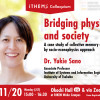
Bridging physics and society: A case study of collective memory dynamics by socio-econophysics approach
2023年11月20日(月) 15:00 - 16:30
佐野 幸恵 (筑波大学 システム情報系 准教授)
The movements of individuals with free will are unpredictable, complex, and, needless to say, fundamentally distinct from the movements of matter. Furthermore, studying society, which forms collectives while engaging in intricate individual interactions, using mathematical models seems incredibly daunting. However, when analyzing empirical data, relatively simple mathematics often emerge in the distribution and dynamics of society at the level of collective behavior. Additionally, such mathematics often share commonalities with physical phenomena. With this background, research is progressing by applying ideas from physics to social-economic phenomena, a field known as socio-econophysics. In this presentation, I will introduce a mathematical model that addresses the decay of collective memory using access logs on the web as an example of research in socio-econophysics.
会場: 大河内記念ホール / via Zoom
イベント公式言語: 英語
73 イベント