
講演会・レクチャー
64 イベント
-
講演会・レクチャー

Lectures on General Probabilistic Theories: From Introduction to Research Participation
2025年10月6日(月) - 9日(木)
荒井 駿 (東京大学 大学院総合文化研究科 JSPS特別研究員)
(The deadline of the registration is on Sep 30.) 100 years have passed since quantum mechanics was born. The mathematical model has been describing the physical world remarkably well. However, the foundations of this model still remain unclear. A comprehensive understanding of quantum theory, including its foundations, is becoming even more important in an era where the demands of realizing quantum information technologies pose significant theoretical and experimental challenges. The framework of General Probabilistic Theories (GPTs) is a modern approach to the foundations of quantum theory. It deals with mathematical generalizations of both classical and quantum theories and has attracted increasing attention in recent years. Roughly speaking, research on GPTs has three major objectives: characterizing the models of classical and quantum theories, investigating the fundamental limits of physical and information-theoretic properties arising from operational requirements, and deepening our understanding of the mathematical structures underlying classical and quantum theories. The studies of GPTs have provided many new perspectives on these topics. However, at the same time, there remain many important open problems in the field. For this reason, more researchers are encouraged to enter and contribute to research on GPTs. This intensive three-day lecture series is designed to provide researchers and graduate students with the essential knowledge necessary for research on GPTs, starting from an introduction to the subject. The lectures will cover the mathematical foundations, physical and information-theoretic concepts, and both the established results and future directions of GPT research. The 1st day will present the necessary mathematical structures, including convex geometry, positive cones, and the operational formulation of probabilistic models. The 2nd day will explore composite systems, information-theoretic quantities, symmetries, and Euclidean Jordan algebras. The 3rd day will survey key results on discrimination and communication tasks, the characterization of classical and quantum theories, and open problems that connect GPTs to quantum information science and beyond. Note: The content of each lecture may extend into the next slot or be covered earlier, depending on the pace of discussion and participant questions. The 1st day (6th Oct.): Mathematical Introduction to GPTs Venue: Large Meeting Room, 2F, Wako Welfare & Conference Building 10:30-12:00 Lecture 1 (Introduction and Mathematics on Positive Cones) 12:00-13:30 Lunch time 13:30-15:00 Lecture 2 (Mathematics on Positive Cones) 15:00-15:30 Coffee break 15:30-17:00 Lecture 3 (Introduction to General Models and Relation between Operational Probability Theories) The 2nd day (7th Oct.): Physical and Information Theoretical Concepts in GPTs Venue: Large Meeting Room, 2F, Wako Welfare & Conference Building 10:30-12:00 Lecture 4 (Composite Systems in GPTs) 12:00-13:30 Lunch time 13:30-15:00 Lecture 5 (Information Quantities) 15:00-15:30 Coffee break 15:30-17:00 Lecture 6 (Dynamics, Symmetry, and Euclidean Jordan Algebras) The 3rd day (8th Oct): Previous and Future Studies in GPTs Venue: Meeting Room 435-437, 4F, Wako Main Research Building 10:30-12:00 Lecture 7 (Discrimination and Communication Tasks) 12:00-13:30 Lunch time 13:30-15:00 Lecture 8 (Characterization of Classical and Quantum Theories) 15:00-15:30 Coffee break 15:30-17:00 Lecture 9 (Other Topics, Open Problems, and Future Directions) 18:00- Dinner The day of no lecture (9th Oct): Open Discussion and Q&A Research discussions will take place between the lecturer and participants in areas such as the hallways on the 3rd and 4th floors of the Main Research Bldg, RIKEN Wako Campus.
会場: 理化学研究所 和光キャンパス 統合支援施設2階会議室 / 研究本館 435-437号室
イベント公式言語: 英語
-
講演会・レクチャー
8th QGG Intensive Lecture: Quantum reference frames and their applications in high-energy physics
2025年9月24日(水) - 26日(金)
Philipp Höhn (沖縄科学技術大学院大学 (OIST) 量子ビットと時空ユニット 助教)
Quantum reference frames (QRFs) are a universal tool for dealing with symmetries in quantum systems. Roughly speaking, they are internal subsystems that transform in some non-trivial way under the symmetry group of interest and constitute the means for describing quantum systems from the inside in purely relational terms. QRFs are thus crucial for describing and extracting physics whenever no external reference frame for the symmetry group is available. This is in particular the case when the symmetries are gauge, as in gauge theory and gravity, where QRFs arise whenever building physical observables. The choice of internal QRF is typically non-unique, giving rise to a novel quantum form of covariance of physical properties under QRF transformations. This lecture series will explore this novel perspective in detail with a specific emphasis on applications in high-energy physics and gravity. I will begin by introducing QRFs in mechanical setups and explain how they give rise to quantum structures of covariance that mimic those underlying special relativity. I will explain how this leads to subsystem relativity, the insight that different QRF decompose the total system in different ways into gauge-invariant subsystems, and how this leads to the QRF dependence of correlations, entropies, and thermal properties. We will then explore how relational dynamics in Hamiltonian constrained systems and the infamous "problem of time" can be addressed with clocks identified as temporal QRFs. In transitioning to the field theory setting, we will first consider hybrid scenarios, where QRFs are quantum mechanical, but the remaining degrees of freedom are quantum fields including gravitons. I will explain how this encompasses the recent discussion of "observers", generalized entropies, and gravitational von Neumann algebras by Witten et al. and how subsystem relativity leads to the conclusion that gravitational entanglement entropies are observer dependent. We will then discuss the classical analog of QRFs in gauge theory and gravity and how they can be used to build gauge-invariant relational observables and to describe local subsystems. This will connect with discussions on edge and soft modes in the literature, the former of which turn out to be QRFs as well. This has bearing on entanglement entropies in gauge theories, which I will describe on the lattice, providing a novel relational construction that overcomes the challenges faced by previous constructions, which yielded non-distillable contributions to the entropy and can be recovered as the intersection of "all QRF perspectives". Finally, I will describe how the classical discussion of dynamical reference frames can be used to build a manifestly gauge-invariant path integral formulation that opens up novel relational perspectives on effective actions and the renormalization group in gravitational contexts, which is typically plagued by a lack of manifest diffeomorphism-invariance. I will conclude with open questions and challenges in the field. Program: September 24 10:15 - 10:30 Registration and reception with coffee 10:30 - 12:00 Lecture 1 12:00 - 13:30 Lunch 13:30 - 15:00 Lecture 2 15:00 - 16:00 Coffee break 16:00 - 17:00 Lecture 3 17:10 - 18:10 Short talk session 18:20 - 21.00 Banquet September 25 10:15 - 10:30 Morning discussion with coffee 10:30 - 12:00 Lecture 4 12:00 - 13:30 Lunch 13:30 - 15:00 Lecture 5 15:00 - 16:00 Coffee break 16:00 - 17:00 Lecture 6 17:10 - 18:10 Short talk session September 26 10:15 - 10:30 Morning discussion with coffee 10:30 - 12:00 Lecture 7 12:00 - 13:30 Lunch 13:30 - 15:00 Lecture 8 15:00 - 16:00 Coffee break 16:00 - 17:00 Lecture 9 & Closing
会場: 研究本館 4階 435-437号室
イベント公式言語: 英語
-
講演会・レクチャー
Matter-Wave Interferometry in the Limit of High Mass and Internal Complexity, and the Relevance of Optomechanical Sources
2024年12月16日(月) 10:00 - 11:00
Markus Arndt (Professor, University of Vienna, Austria)
The seminar will feature a lecture by Professor Markus Arndt from the University of Vienna. Following the lecture, starting at approximately 11:00 AM, Nobuyuki Matsumoto will give a brief introduction to his research and conduct a tour of his laboratory. Hosted by Gakushuin University Co-hosted by iTHEMS
会場: 学習院大学 南4号館 007号室
イベント公式言語: 英語
-
講演会・レクチャー
第6回中高生のためのオンライン特別授業「今、神戸でアツい科学」
2024年11月2日(土) 10:30 - 14:30
砂川 玄志郎 (理化学研究所 生命機能科学研究センター (BDR) 冬眠生物学研究チーム チームリーダー)
佐藤 賢斗 (理化学研究所 計算科学研究センター (R-CCS) 高性能ビッグデータ研究チーム チームリーダー)
足立 景亮 (理化学研究所 数理創造プログラム (iTHEMS) 研究員)
サフィエ・エスラ・サルペル (理化学研究所 生命機能科学研究センター (BDR) 発生幾何研究チーム 基礎科学特別研究員)さまざまな研究が行われている理化学研究所。今回は神戸キャンパスで研究をしている数理科学、情報科学、生物学の 4 名の研究者がお話しします。iTHEMSからは足立 景亮 研究員が物理学やコンピュータを使って、集団での動きのしくみを解き明かそうとする研究を紹介します。 参加希望の方は、関連リンクよりイベントサイトで受講方法をご確認下さい。
会場: via Zoom
イベント公式言語: 日本語
-
講演会・レクチャー
Differential Topology Seminar: Rigidity and Flexibility of Isometric Embeddings
2024年7月16日(火) 15:00 - 16:30
Dominik Inauen (Academic Staff, University of Leipzig, Germany)
The problem of embedding abstract Riemannian manifolds isometrically (i.e. preserving the lengths) into Euclidean space stems from the conceptually fundamental question of whether abstract Riemannian manifolds and submanifolds of Euclidean space are the same. As it turns out, such embeddings have a drastically different behaviour at low regularity (i.e. C1) than at high regularity (i.e. C2). For example, by the famous Nash--Kuiper theorem it is possible to find C1 isometric embeddings of the standard 2-sphere into arbitrarily small balls in R3, and yet, in the C2 category there is (up to translation and rotation) just one isometric embedding, namely the standard inclusion. Analoguous to the Onsager conjecture in fluid dynamics, one might ask if there is a sharp regularity threshold in the Holder scale which distinguishes these flexible and rigid behaviours. In my talk I will review some known results and argue why the Holder exponent 1/2 can be seen as a critical exponent in the problem.
会場: 京都大学 理学研究科 6号館609号室
イベント公式言語: 英語
-
講演会・レクチャー
Obstructions to Lagrangian surgery
2024年6月27日(木) 15:00 - 17:00
Emmy Murphy (Professor, Princeton University, USA)
Given a Lagrangian immersion with a transverse double point, we can surger this point to obtain an embedded Lagrangian with more complicated topology. As a classical example, both the Clifford and Chekanov tori in C2 are obtained via Lagrangian surgery on a immersed sphere called the Whitney sphere. In the talk we'll discuss a Floer-theoretic obstruction to this: that is, showing that a Lagrangian cannot be realized as a surgery. An interesting dilemma is that PH invariants of an immersed Lagrangian itself cannot detect the fact that it is immersed. Instead, we have to consider families of Floer invariants coming from all possible surgeries, and use properties specific to SFT Lagrangian cobordism maps.
会場: 京都大学数理解析研究所
イベント公式言語: 英語
-
講演会・レクチャー
Liouville symmetry groups and pseudo-isotopies
2024年6月25日(火) 17:00 - 18:30
Emmy Murphy (Professor, Princeton University, USA)
Even though Cn is the most basic symplectic manifold, when n>2 its compactly supported symplectomorphism group remains mysterious. For instance, we do not know if it is connected. To understand it better, one can define various subgroups of the symplectomorphism group, and a number of Serre fibrations between them. This leads us to the Liouville pseudo-isotopy group of a contact manifold, important for relating (for instance) compactly supported symplectomorphisms of Cn, and contacomorphisms of the sphere at infinity. After explaining this background, the talk will focus on a new result: that the pseudo-isotopy group is connected, under a Liouville-vs-Weinstein hypothesis.
会場: 東京大学数理科学研究科数理科学研究科棟 056号室 (メイン会場) / via Zoom
イベント公式言語: 英語
-
講演会・レクチャー
Rigidity and Flexibility of Isometric Embeddings
2024年6月20日(木) 17:00 - 18:30
Dominik Inauen (Academic Staff, University of Leipzig, Germany)
The problem of embedding abstract Riemannian manifolds isometrically (i.e. preserving the lengths) into Euclidean space stems from the conceptually fundamental question of whether abstract Riemannian manifolds and submanifolds of Euclidean space are the same. As it turns out, such embeddings have a drastically different behaviour at low regularity (i.e. C^1) than at high regularity (i.e. C^2). For example, by the famous Nash--Kuiper theorem it is possible to find C1 isometric embeddings of the standard 2-sphere into arbitrarily small balls in R^3, and yet, in the C^2 category there is (up to translation and rotation) just one isometric embedding, namely the standard inclusion. Analoguous to the Onsager conjecture in fluid dynamics, one might ask if there is a sharp regularity threshold in the Holder scale which distinguishes these flexible and rigid behaviours. In my talk I will review some known results and argue why the Holder exponent 1/2 can be seen as a critical exponent in the problem.
会場: 東京大学駒場キャンパス 数理科学研究科
イベント公式言語: 英語
-
講演会・レクチャー
An introduction to the exact WKB analysis via the hypergeometric differential equation
2024年2月19日(月) - 22日(木)
青木 貴史 (近畿大学 理工学部 名誉教授)
This is an introductory course to the exact WKB analysis. Firstly we review some basic facts concerning formal power series and WKB solutions. Secondly we give an overview of the connection formulas for WKB solutions to ordinary differential equations of second order with a large parameter. Next, after recalling some classical theory for the Airy equation and the Gauss hypergeometric differential equation, we show how the exact WKB analysis is used for these equations and what are obtained. One of the main results to be presented in this course is the relation the between the classical hypergeometric function and the Borel resummed WKB solutions to the hypergeometric differential equation with a large parameter. Some applications and recent topics are also given. [Schedule (Tentative)] Day 1 10:00 - 11:30 Lecture 1 14:00 - 16:00 Lecture 2 Day 2 10:00 - 11:30 Lecture 3 14:00 - 16:00 Lecture 4 Day 3 10:00 - 11:30 Lecture 5 14:00 - 16:00 Lecture 6 Day 4 10:00 - 11:30 Lecture 7 14:00 - 16:00 Lecture 8
会場: セミナー室 (359号室) (メイン会場) / via Zoom
イベント公式言語: 英語
-
講演会・レクチャー
Introduction to Effective Field Theory and Many-Body Problems
2023年12月27日(水) - 28日(木)
本郷 優 (新潟大学 理学部 物理学プログラム 助教)
Quantum field theory (QFT) has been formulated as a theoretical tool to describe elementary particles and nuclei. However, after introducing the concept of "effective field theory," QFT has been providing a general and powerful theoretical framework for describing various universal phenomena in broader range of physical systems, including condensed matter physics and statistical physics. In this lecture, we will explore the basic aspects of field theory by employing it to address quantum many-body problems in simple nonrelativistic systems. The topics covered will include: Lecture 1: Low-energy scattering and renormalization in quantum mechanics Lecture 2: Effective field theory of low-energy scattering Lecture 3: Spontaneous symmetry breaking in weakly-interacting bose gas Lecture 4: Effective field theory of superfluid Lecture 5: Introduction to in-medium potential Lecture 6: Complex-valued in-medium potential between heavy impurities in ultracold atoms The aim is to provide an introductory overview and explanation of basics concepts in field theory. Schedule: Wed., Dec. 27 10:00 - 11:30: Lecture 1 13:00 - 14:30: Lecture 2 15:00 - 16:30: Lecture 3 Thur., Dec. 28 10:00 - 11:30: Lecture 4 13:00 - 14:30: Lecture 5 15:00 - 16:30: Lecture 6
会場: 研究本館 3階 359号室とZoomのハイブリッド開催
イベント公式言語: 英語
-
講演会・レクチャー
Rapid development of cold-atom quantum computers and their prospect
2023年12月26日(火) 13:30 - 17:00
富田 隆文 (分子科学研究所 光分子科学研究領域 助教)
Note for participants: For on-site participants, please register via the registration form. For online participants finding the Zoom link, you can get it after filling the registration form. Program: 13:30-15:00 Lecture 1 15:00-15:30 Coffee break 15:30-17:00 Lecture 2 Abstract: In this talk, I will give an overview of the recent rapid progress of cold-atom quantum computers. In a cold-atom quantum computer, a laser-cooled atomic gas in a vacuum chamber is captured with a two-dimensional trap array called an optical tweezers array, which is an array of tightly focused laser beams. An array of cold single atoms thus created is initialized, gate operated, and readout with other laser beams. Because of its controllability and scalability, the cold-atom quantum computer has been attracting much attention, as one of the most promising candidates in the race to develop quantum-computer hardware. I will describe the characteristics and development trends of the cold-atom hardware, as well as the development of a cold-atom quantum computer at Institute for Molecular Science including the realization of an ultrafast quantum gate using ultrashort laser pulses.
会場: 研究本館 4階 435-437号室 (メイン会場) / via Zoom
イベント公式言語: 英語
-
講演会・レクチャー
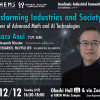
Transforming Industries and Society: The Power of Advanced Math and AI Technologies
2023年12月12日(火) 16:30 - 18:00
穴井 宏和 (富士通株式会社 富士通研究所 プリンシパルリサーチディレクター)
In this talk, we will review the history and the latest trends in artificial intelligence (AI) and mathematical technologies in recent years. We will also introduce various real-world problem-solving efforts that utilize state-of-the-art mathematics and artificial intelligence technology. Additionally, we will explore the role of mathematical and AI technologies and the social value they bring, while providing examples of their applications in a wide range of fields, such as manufacturing, disaster prevention, medical care, and institutional design in society. Furthermore, we will consider the thinking and skills required to address industrial and social issues using mathematical and AI technologies. The technologies that will be discussed in this talk include the following keywords: mathematical modeling, simulation, optimization, deep learning, topological data analysis, causal discovery, game theory, matching theory, and social mathematics.
会場: 大河内記念ホール (メイン会場) / via Zoom
イベント公式言語: 英語
-
講演会・レクチャー
Higher Algebra in Geometry
2023年7月31日(月) - 8月10日(木)
Hiro Lee Tanaka (Assistant Professor, Department of Mathematics, Texas State University, USA)
In these lectures, we will shed light on modern tools of higher algebra, where the traditional structures of algebra yield themselves only after controlled deformations. We will introduce infinity-categories, spectra, operads, and other standard tools of the last decade. The main applications will be to encode various higher-algebraic structures that inevitably arise in, and shed light on, geometry and topology. If time permits, we will illustrate how spectra naturally arise in geometric invariants. The audience is imagined to consist of mathematicians interested in applications of infinity-categorical tools -- so a broad range of geometers (including topologists) and algebraists. From Lecture Two onward, I will assume basic knowledge of algebraic topology (e.g., the material of Hatcher) and homological algebra. These lectures will be held between July 31 and August 10, each from 10:30 to 12:00, for a total of 8 lectures. 1st Week: Jul 31(mon), Aug 1(tue) - 3(thu) - Introduction to ideas of higher algebra in geometry, for a general audience. - Introduction to infinity-categories and to spectra. 2nd Week: Aug 7(mon) - 10(thu) - Examples in geometry and topology, including invariants of Legendrian links and generating functions. - Future Directions. Profile: Hiro Lee Tanaka is an assistant professor in the Department of Mathematics. After receiving his Ph.D. from Northwestern University and completing postdoctoral work at Harvard University, he conducted research at the Mathematical Sciences Research Institute in Berkeley, California, and at the Isaac Newton Institute in Cambridge, England. His research aims to fuse the higher structures in modern algebra with geometries emerging from both classical mechanics and supersymmetric field theories. Beyond research, Tanaka engages in efforts to create more equitable and supportive environments throughout the mathematics community.
会場: 研究本館 4階 435-437号室 / via Zoom
イベント公式言語: 英語
-
講演会・レクチャー
3rd QGG Intensive Lectures: Spinfoam path integrals for Quantum Gravity
2023年7月26日(水) - 28日(金)
Etera Livine (Research Director CNRS, Ecole Normale Supérieure de Lyon, France)
At the crossroads of several approaches to quantum gravity, Spinfoams propose a discrete path integral for quantum general relativity built from topological field theory. With the spectrum of geometric operators directly read from the representation theory of the local symmetry group, they can be interpreted as a quantized version of Regge calculus and can be understood as implementing the dynamics of quantum states geometry in loop quantum gravity. I will explain the basics of the formalism, the motivations, the mathematical framework and the main tools. In three space-time dimensions, the spinfoam quantization of 3d gravity is given by the Turaev-Viro topological invariant, which is intimately related to the quantization of Chern-Simons theory. I will explain in particular how the spinfoam amplitudes solve the Wheeler-de Witt equation, implement the invariance under 3d diffeomorphisms (despite being formulated in a discretized space-time) and lead to a quasi-local version of holography. In four space-time dimensions, general relativity can be formulated as an almost-topological theory and I will explain how the existing spinfoam models introduce a sea of topological defects to re-create the gravitational degrees of freedom from a topological path integral. Finally, I will show how spinfoams are naturally defined in terms of group field theory, which are generalized tensor models, and the prospects that this opens. I will conclude with the main challenges and open lines of research of the field. Program: July 26 10:00 - 10:15 Registration and reception 10:15 - 11:45 Lecture 1 11:45 - 13:30 Lunch & coffee break 13:30 - 15:00 Lecture 2 15:00 - 16:00 Coffee break 16:00 - 17:00 Lecture 3 17:10 - 18:30 Short talk session July 27 10:00 - 11:45 Lecture 4 11:45 - 13:30 Lunch & coffee break 13:30 - 15:00 Lecture 5 15:00 - 16:00 Coffee break 16:00 - 17:00 Lecture 6 17:30 - 20:00 Banquet July 28 10:00 - 11:45 Lecture 7 11:45 - 13:30 Lunch & coffee break 13:30 - 15:00 Lecture 8 15:00 - 16:00 Coffee break 16:00 - 17:30 Lecture 9 & Closing
会場: 研究本館 4階 435-437号室
イベント公式言語: 英語
-
講演会・レクチャー

NU-Q-iTHEMS-YITPレクチャー:量⼦計算の場の量⼦論への応⽤
2023年7月6日(木) - 7日(金)
本多 正純 (京都大学 基礎物理学研究所 助教)
量子計算の場の量子論の数値シミュレーションへの応用について、入門的な解説を行う。まず量子計算の基礎的な部分を解説した後に、量子計算のスピン系のシミュレーションへの応用について議論する。その後連続的場の量子論・および格子上の場の量子論に関する入門的な解説を行い、場の量子論のシミュレーションについて議論する。また、IBM qiskitを用いた量子シミュレーションの実習も行う。 実習参加者への注意: 実習に使うノートPCの貸出はないので、ご持参するようお願いします。 予めAnacondaなどを導入するなどして、Jupyter Notebookを使えるように環境を整えておくようお願いいたします。 主催:新潟⼤学量⼦研究センター (NU-Q)、 京都⼤学基礎物理学研究所 (YITP) 共催:理化学研究所 数理創造プログラム (iTHEMS)
会場: 新潟大学 理学部A棟 A317号室(大会議室) / via Zoom
イベント公式言語: 日本語
-
講演会・レクチャー
2nd QGG Intensive Lectures: Large gauge transformation and infrared regularity in the inflationary universe
2023年6月19日(月) - 20日(火)
田中 貴浩 (京都大学 大学院理学研究科 物理学・宇宙物理学専攻 教授)
In this lecture we will start with the general framework to analyse the density perturbation in the inflationary universe. Then, we will introduce various infrared (IR) phenomena, including IR divergences, delta N formalism and consistency relation. The underlying symmetry originally coming from 3D diffeomorphism invariance leads us to a harmonic and unified understanding of these phenomena. Program: June 19 10:00 - 10:15 Registration and reception (with coffee) 10:15 - 11:45 Lecture 1 11:45 - 13:30 Lunch & coffee break 13:30 - 15:00 Lecture 2 15:00 - 16:00 Coffee break 16:00 - 17:30 Lecture 3 17:45 - 18:30 Short talk session June 20 10:00 - 10:15 Reception (with coffee) 10:15 - 11:45 Lecture 4 11:45 - 13:30 Lunch & coffee break 13:30 - 15:00 Lecture 5 15:00 - 16:00 Coffee break 16:00 - 17:30 Lecture 6 17:30 - 18:30 Discussions & Closing
会場: 研究本館 5階 535-537号室
イベント公式言語: 英語
-
講演会・レクチャー
Introduction to the Quantum Theory of Gravity via Asymptotic Safety
2023年1月24日(火) - 26日(木)
太田 信義 (Visiting Professor, Department of Physics, National Central University, Taiwan)
We give an introduction to the formulation towards the quantum theory of gravity using the functional (or exact) renormalization group, the so-called asymptotic safety. First we briefly explain the necessity of quantization of gravity and why the Einstein gravity is not sufficient for this purpose. Second, we introduce the functional renormalization group equation and explain what is the asymptotic safety program to achieve the quantum theory of gravity. This includes the notion of relevant, irrelevant and marginal operators, and it is important that there are finite number of relevant operators to make any prediction of quantum effects. This gives a nonperturbatively renormalizable theory of gravity. We then discuss various examples how the program may be applied to various theories, and summarize the current status of this approach. (Tentative schedule) [Day 1: Jan. 24, 2023] Free discussion: 9:30 - 10:30 Lecture 1: 10:30 - 12:00 Lunch: 12:00 - 13:30 Lecture 2: 13:30 - 15:00 Break: 15:00 - 15:30 Lecture 3: 15:30 - 17:00 [Day 2: Jan. 25, 2023] Free discussion: 9:30 - 10:30 Lecture 4: 10:30 - 12:00 Lunch: 12:00 - 13:30 Lecture 5: 13:30 - 15:00 Break: 15:00 - 15:30 Lecture 6: 15:30 - 17:00 [Day 3: Jan. 26, 2023] Q&A + discussion: 9:30 - 15:00
会場: 研究本館 5階 535-537号室
イベント公式言語: 英語
-
講演会・レクチャー
An Introduction to Quantum Measurement Theory for Physicists
2022年11月10日(木) - 12日(土)
堀田 昌寛 (東北大学 大学院理学研究科物理学専攻 助教)
In this lecture, basic concepts in quantum measurement theory are introduced, including measurement operators and POVM's. The related topics are also picked up. Lecture 1: Nov. 10, 10:30 - 12:00 Lecture 2: Nov. 10, 13:30 - 15:00 Lecture 3: Nov. 10, 15:30 - 17:00 Lecture 4: Nov. 11, 10:30 - 12:00 Lecture 5: Nov. 11, 13:30 - 15:00 Lecture 6: Nov. 12, 10:30 - 12:00
会場: 研究本館 3階 345−347号室 (メイン会場) / via Zoom
イベント公式言語: 英語
-
講演会・レクチャー

Introduction to Topological Insulators: From Quantum to Classical Physics 4
2022年4月27日(水) 15:00 - 17:00
小澤 知己 (東北大学 材料科学高等研究所 (AIMR) 准教授)
In this set of lectures, I give an introduction to topological insulators. A goal is to provide an overall understanding of basic concepts of the physics of topological insulators to mathematicians and physicists with no prior knowledge on the subject. Very roughly speaking, topological insulators are materials whose wavefunctions show nontrivial topological structure in momentum space. Materials with topologically nontrivial wavefunction in momentum space have been found to host modes which are localized at the surface (edge) of the material: a property known as the bulk-edge correspondence. The bulk-edge correspondence results in experimentally observable signature of somewhat abstract notion of topology of the wavefunction in momentum space. Originally, topological insulators were found and studied for electrons in solid-state materials, which are quantum mechanical. However, certain properties of topological insulators, including the bulk-edge correspondence, have been found to hold also for purely classical materials, such as electromagnetic waves obeying Maxwell’s equations, or waves described by Newtonian mechanics. I will try to introduce topological insulators in a way general enough to be applied to quantum as well as classical materials. In the final part of the lectures, I take this opportunity to discuss some of my own works, where I studied some relations between the two-dimensional topological insulators and Kähler geometry.
会場: via Zoom
イベント公式言語: 英語
64 イベント