

Math Is for Everyone—The Story Behind the MEXT Poster “Mathematics Connecting to the World”
The poster for “Mathematics Connecting to the World: One S&T poster for Every Household,” part of a series by the Ministry of Education, Culture, Sports, Science and Technology (MEXT), catches the eye with its bright and colorful design. We spoke with two key members of the team behind the poster: Tomoya Nagai (right in photo), Coordinator and Director of the Office of the Center Director at the RIKEN Interdisciplinary Theoretical and Mathematical Sciences Program (iTHEMS), and Takuya Shimada (left in photo), planner and science communicator.
Affiliation and position are as of the interview date: January 2025
(Written and Photographed by Naoko Shinozaki (Freelance Announcer / Mathematics Communicator))
What are your respective roles?
Nagai: As a Coordinator at iTHEMS, I’m involved in a wide range of tasks that support research and public outreach.
Shimada: I primarily work in science communication. Until spring 2023, I spent about 20 years at the Miraikan (National Museum of Emerging Science and Innovation) in Odaiba, working on exhibition planning. Before that, I worked in interaction design at a design firm. While the title “science communicator” usually suggests someone who explains things directly to people, I focus on conveying science through tangible objects or curated environments rather than verbal explanation.
We heard you met at the Miraikan
Shimada: My final project at the design firm after graduating college was an exhibition for the Miraikan. When we delivered it, I felt that exhibitions would be better curated internally by the museum itself, so I decided to join Miraikan. Although I wanted to work on exhibitions, I was assigned to the web development team, where I was introduced to Mr. Nagai as a collaborator.
Nagai: After completing my PhD and working as a postdoc for about two years, I joined the Miraikan, where I was tasked with building a proper web team. That’s where I met Mr. Shimada , and we worked together for about a year and a half.
What kinds of projects did you work on together?
Nagai: The Miraikan opened in July 2001, and the first year was full of trial and error. We were constantly experimenting with how to realize different ideas. Around that time, new web technologies were emerging rapidly, and we tried many of them. For instance, video streaming was still novel back then. We set up our own server and streaming system at the museum to deliver video content. Within our limited budget, we brainstormed ways to engage people—and together with Mr. Shimada, we tackled many such challenges.
Shimada: Our section mainly focused on media-based outreach. Since I wanted to do something unique, I proposed a one-person “science goods” team and created science-themed products. I’ve always loved making things, and since I couldn’t work on exhibitions directly, I poured scientific essence into physical products that people could hold. Although I worked on web tasks as well, around 80% of my time was dedicated to creating goods.
Nagai: While web content is a standard outreach method, I interpreted our scope more freely—anything that could engage people was fair game. I strongly resonated with Mr. Shimada’s approach of using physical goods to bring science closer to people. That spirit definitely influenced the poster project too.
What inspired you to apply for the “One S&T poster for Every Household” project?
Nagai: When I joined iTHEMS in April 2023, MEXT announced an open call for its “One S&T poster for Every Household.” I had known about the series since the first periodic table poster came out 20 years ago and had always hoped to create one someday. iTHEMS also encouraged submitting a proposal themed around mathematics.
I myself originally specialized in theoretical astronomy and conducted research closely related to mathematics, but I’ve always felt it’s difficult to convey the broader context of such work, even to researchers themselves. This was a perfect opportunity to organize and communicate those ideas, so I chose “mathematics” as the theme.
What was the creation process like?
Nagai: We had limited time, so I expected a tough production process. We constantly worked within various constraints, thinking about how to make the best product under those conditions. I built a team and asked iTHEMS members for help.
There were unexpected difficulties along the way, but thanks to support from MEXT staff, iTHEMS collaborators, the design company, and Mr. Shimada’s contributions, the pieces came together very well.
Shimada: I handled the design direction, developing a clear visual concept we could bring to the design firm. I also advised on the structure, helping ensure that the proposal’s core ideas would translate visually.
Initially, the draft leaned toward an internal researcher’s perspective—how researchers might categorize or present mathematics. But since the target audience includes younger students, we had to adjust the content to a more relatable, meaningful context for them. I focused on this shift early in the process.
What aspect of the poster did you focus on most?
Nagai: My goal was to convey how mathematics, numbers, and logical thinking are used in many aspects of life. We expressed this as “using mathematics as a tool.” I especially focused on selecting and arranging the “items”—the icons outside the central circle on the poster. Since there’s limited space, it felt like solving a tough puzzle: choosing meaningful, illustrative items and placing them for the greatest effect. Each had to be relevant, and we eventually arrived at the final composition.
Shimada: This is the 20th poster in the “One S&T poster for Every Household” series. Earlier posters often used dark tones like blue, black, or brown, creating a “textbook” feel that can make science seem distant. I wanted to break from that tradition by using all seven colors of the rainbow. When this poster appears in schools, I believe it instantly feels fresh and different—visually signaling that something new has arrived.
What message did you want to convey through the poster?
Nagai: I hope people really do hang it in their homes—and that it sparks conversations among family members. If displayed at workplaces, maybe it will become a conversation starter between colleagues or managers and subordinates. I’d love for it to be a communication catalyst in all kinds of settings.
It ties back to the “science goods” idea: something people see or pick up can inspire new perspectives or ideas. I’d be thrilled if this poster becomes a tool for that.
Shimada: The key message for me was “Let’s use mathematics.” I also came up with the tagline, “Mathematics as a tool.”
So many people feel like they “fall behind” in math by middle school, thinking they’re not good at it. Whether that’s true or not, we’ve collectively bought into a story that half the population is expected to give up on math. But that’s such a waste! Our entire world is built on mathematics. It’s absurd to accept that most people should “drop out” of it. Everyone has used math and can always return to it. Math belongs to everyone. Even if some parts are challenging, the idea of “falling behind” shouldn’t exist. That’s the belief I wanted to express.
What does “mathematics” mean to you personally?
Shimada: In the poster, we say, “Let’s use mathematics,” but honestly, I already use it all the time in my work and life—naturally. Maybe the general public doesn’t need to consciously label it “mathematics.” Ideally, math becomes more unconscious—part of the everyday. Thinking with logical reasoning, playing with quantities, thinking step by step—these are all mathematical acts. Even if people forget the word, they’re still using it. That’s why it’s such a shame when people stop thinking that way just because they think math isn’t “for them.”
Nagai: “Using math” doesn’t only mean solving equations—it includes thinking logically, breaking things down into steps, persuading others, creating new products, and contributing to society. That kind of thinking is essential for making use of humanity’s accumulated knowledge. That, too, is mathematics.
What are your hopes moving forward?
Nagai: We hosted a workshop at RIKEN’s open house using the poster. I’d like that kind of activity to expand—turning the poster into a springboard for new developments.
Whether through events, new goods, books, or games, I hope this idea of “mathematics as a tool” continues to grow beyond the poster. I want to keep pushing for new ways to express it.
Shimada: The workshop was really fun! As Mr. Nagai said, the poster should be the core of a whole range of activities. We’ve only made one workshop so far, but I’d love to archive it and turn it into a manual that teachers can use in schools everywhere. I hope we can create many sharable resources like that.
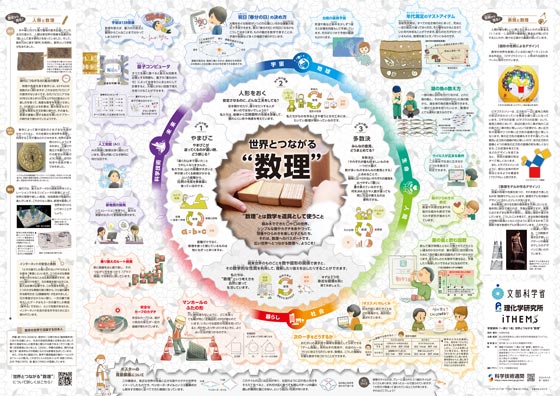
MEXT poster “Mathematics Connecting the World”
Download the poster (A3 PDF 6.3 MB)