

Looking for “Overlap” to Connect
Akihisa Yamamoto
(Research Scientist, RIKEN Interdisciplinary Theoretical and Mathematical Sciences Program (iTHEMS))
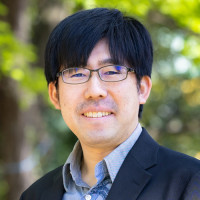
"I have always walked along the boundaries between different fields," says Research Scientist Akihisa Yamamoto. Currently, he is focusing on the interdisciplinary field between medicine and mathematics , seeking to identify patterns in doctors' experiential knowledge, translating them into mathematical models, and applying them to deepen our understanding of biological phenomena while contributing to clinical practice. We spoke with him about the encounters that led him to this path, as well as the unique challenges and excitement of working at the intersection of disciplines.
Keywords: Medicine and Mathematics, Interdisciplinary Research, Mathematical Models, Biophysics, Corneal Endothelium, Nonlinear Physics
Affiliation and position are as of the interview date: November 2024
Current position: Visiting Scientist, Division of Fundamental Mathematical Science, RIKEN Center for Interdisciplinary Theoretical and Mathematical Sciences (iTHEMS)
(Written by Shino Suzuki (Photon Create Co., Ltd.) / Photographed by Makoto Oikawa (Photographer))
Walking the Boundary Between Fields
"My research applies the perspectives of physics and mathematics to determine whether tissues and cells are normal or diseased, predict disease progression and treatment efficacy, and ultimately contribute to medicine," Yamamoto explains. He continues, "My journey began with physics, but through many encounters, I gradually connected my research to biophysics, medicine, and mathematics. I believe what makes me unique is having always worked in interdisciplinary fields."
The starting point of this journey was a lecture on nonlinear physics that he attended in the third year of his undergraduate course of university. Yamamoto had enrolled in the Faculty of Science at Kyoto University with the intention of studying physics, but he found himself equally fascinated by biology, chemistry, and mathematics in the general education curriculum. While wondering about a single field to pursue as his main focus, he encountered an approach that used nonlinear physics to describe living systems—an area seemingly far away from traditional physics. This encounter was both surprising and captivating. Inspired by Professor Kenichi Yoshikawa’s enthusiasm for this perspective throughout his lectures, Yamamoto decided to pursue graduate studies in Yoshikawa’s laboratory.
One day, while working on a cell membrane model in the lab, one of his senior colleagues invited him to a gathering of the "Young Researchers' Meeting in Biophysics." "To be honest, I wasn’t too eager to go. I’ve always been a reserved person who prefers staying at home," Yamamoto recalls with a chuckle. However, when he attended, he found himself drawn in. "The meeting brought together young researchers and students from all over Japan working at the intersection of biology and physics. Some were conducting experiments with bacteria and proteins. As I was beginning to develop an interest in biology while using physics to understand life, this event gave me invaluable exposure to a perspective different from my daily lab activities."
Despite his initial hesitation, he went on to take charge of organizing a summer school event and eventually became the chair of the young researchers' meeting. He explains, "Because I’m not naturally good at talking to people, I push myself into roles where I must interact with others to build connections. In biophysics, it’s very hard for one person alone to fully grasp both biology and physics. That’s why discussions and knowledge-sharing with others are essential."
The Research Exchange in Germany He Once Declined—Encounters and Lessons Learned
"How would you like to conduct your research in Germany for half a year?" In his second year of doctoral studies, Professor Yoshikawa offered him the opportunity. Yamamoto’s first reaction was, "Oh no, I don’t want to go." He had never studied German, and was not confident communicating in English either. Moreover, he was uncertain about his career in academia after earning his PhD—he was considering entering the workforce instead. "This opportunity would be wasted on me, so I think I better pass," he initially declined. However, after persistent encouragement, he finally decided to go. In September 2012, he left for Heidelberg University in Germany.
In Heidelberg, he joined Professor Motomu Tanaka’s research group, which specialized in biophysical chemistry, and started a new topic on cell membrane models. "My time in Germany turned out to be the biggest turning point in my research career," Yamamoto states unequivocally. Before going abroad, he was overwhelmed by uncertainties about the future. However, once in Germany, he found research to be both challenging and enjoyable, which led him to stop worrying about his future career and simply immerse himself in his studies. The anxiety and self-doubt that had plagued him disappeared. As he spent half a year completely absorbed in research, time flew by.
Yamamoto firmly believes, "If I hadn’t gone to Germany, I wouldn’t have become a researcher." Witnessing Professor Tanaka’s work with live cell experiments, he became interested in incorporating experiments into his own research. This experience clarified his future direction. Moreover, just as he was about to return to Japan, Professor Tanaka offered him to join the new research lab he was setting up at Kyoto University.
Recognizing the Close Connection Between Biology and Medicine, Physics and Mathematics
Back in Kyoto, Yamamoto started learning experimental techniques from scratch in the newly established lab. "When I first learned how to use a pipette, I was incredibly nervous because I felt the pressure to observe everything—the position and angle of the tip, the speed at which the liquid moved. I didn’t want to overlook anything." He mimics the delicate movements with a serious expression before laughing, "That’s just my personality."
As he incorporated live cell experiments into his research, he found himself increasingly engaging in the medical field. "Working in the interdisciplinary field of biology and physics, I’ve realized how closely related biology and medicine are, just as physics and mathematics are deeply intertwined. I now aim to explore the 'overlap' between biology and medicine, and between physics and mathematics, using these connections as a foundation to expand my research," says Yamamoto.
He is also involved in the Kyoto-Heidelberg-RIKEN workshop on "Medicine and Mathematics," which was first held in 2019. The event was initiated due to the connection between iTHEMS Program Director Tetsuo Hatsuda and Professor Tanaka. Yamamoto participated in the workshop and learned that interdisciplinary research bridging medicine and mathematics was also being conducted at RIKEN, sparking his interest in iTHEMS. By the time of the fifth workshop in September 2024, he was not only a participant but also helped organize the event as an iTHEMS researcher.
"Through these workshops, I’ve seen how measurement techniques in clinical settings and data science have advanced, leading to greater volumes and higher-quality data, as well as more sophisticated mathematical models for analysis. This trend will continue to grow. At the same time, medicine consists of many subfields, each requiring tailored mathematical approaches. I hope to further develop research at the interface of medicine and mathematics here at iTHEMS."
Translating Medical Experience into Mathematics for Clinical Application
Yamamoto is deeply committed to bringing his research into clinical practice. One major inspiration came from a joint project with the Department of Ophthalmology in Kyoto Prefectural University of Medicine, which led to a patented technology now used in medical settings.
This technology involves the analysis of the arrangement and collective order of corneal endothelial cells to assess tissue health and diagnose conditions. While several diagnostic indices based on the appearance of single cells existed, the accuracy and reliability were not always promising. Rather than focusing on cell size, shape, or density—common existing metrics—Yamamoto’s team used mathematical formulas to quantify the forces between cells. This novel approach significantly improved diagnostic accuracy, with applications in regenerative medicine, quality control of cells, and prognosis.
Through this research, Yamamoto engaged in extensive discussions with ophthalmologists, learning that while doctors pick up on many things under the surface, they always look for good ways to translate their insights into diagnoses and medical sciences. This led him to a new mission: "I want to translate doctors' intuitive knowledge into mathematical models, quantify it, extract patterns, and apply these findings to medical practice. iTHEMS is the perfect place for this challenge."
Reflecting on his experience at iTHEMS, Yamamoto says, "Being surrounded by top-tier researchers in a flat, open environment where I can freely discuss ideas is fantastic. I feel my brain being stimulated in ways I never experienced before."
Having always worked at disciplinary boundaries, Yamamoto notes that one challenge of interdisciplinary research is the small size of its community. "I want to show both mathematicians and medical professionals that there is an 'overlap' between these fields, attract young researchers, and build a thriving community."
Finally, he shares a message for young researchers: "Have the courage to take a step forward. You might fail, but that’s part of the experience. If I hadn’t taken the leap to study in Germany, I wouldn’t be here today."