
Featured News
-
Using chaos and symmetry to bootstrap quantum gravitational wormholes

An international research collaboration between Gabriele Di Ubaldo (RIKEN-Berkeley Center at UC Berkeley and RIKEN iTHEMS), Jan Boruch (University of California, Berkeley, US), Felix M. Haehl (University of Southampton, UK), Eric Perlmutter (Université Paris-Saclay and Institut des Hautes Études Scientifiques, France), and Moshe Rozali (University of British Columbia, Canada) published the new study in <em>Physical Review Letters</em>. Random matrix theory provides a universal description of chaos in quantum systems, capturing statistical patterns among energy levels without requiring knowledge of microscopic details. The new challenge addressed is its extension to 2D Conformal Field Theories and their holographically dual 3D quantum gravity via the AdS₃/CFT₂ correspondence. In the AdS₃/CFT₂ correspondence, quantum gravity in a three-dimensional negatively curved spacetime is encoded in a two-dimensional conformal field theory on its boundary. The key difference is <strong>modular invariance</strong>, a symmetry stating that a theory on a 2D torus is invariant under modular transformations, which imposes stringent constraints and a rigid mathematical structure, seemingly incompatible with quantum chaos and random matrix theory. Building on the 2023 work of Di Ubaldo and Perlmutter, “AdS₃/RMT₂ duality”, the researchers developed a general, nonperturbative framework called RMT₂ that uplifts the correlations of any random matrix model into fully modular-invariant quantities. The team then used RMT₂ to predict quantum amplitudes for 3D wormholes with multiple torus-shaped boundaries. A wormhole is a tunnel-like geometric connection between otherwise separate regions or boundaries of spacetime. While it is not a shortcut for interstellar travel as in sci-fi movies, it encodes deeply quantum information about gravity and black holes. For the three-boundary wormhole, the team also performed a gravity calculation that agrees with the RMT₂ prediction. By turning the earlier AdS₃/RMT₂ proposal into a general framework, the study advances a research direction that Gabriele helped pioneer and provides a new tool for probing black-hole microstates and, in the near future, solving AdS₃ quantum gravity. For further details, please see the article in <em>Physical Review Letters</em>.
2026-08-07
-
Riccardo Muolo Awarded Third Place at Falling Walls Lab Tokyo 2026

Riccardo Muolo awarded 3rd Place at Falling Walls Lab Tokyo, Japan Riccardo Muolo (Special Postdoctoral Researcher, Division of Fundamental Mathematical Science, iTHEMS) took part in the Falling Walls Lab Tokyo, Japan, held on 28 July 2026 at Shibuya Sakura Stage, and was awarded 3rd Place by the jury. The Falling Walls Lab is an international pitch and science-communication competition hosted by the Falling Walls Foundation, a Berlin-based non-profit founded in 2009 on the twentieth anniversary of the fall of the Berlin Wall. The Foundation channels the spirit of that night to ask a recurring question — which are the next walls to fall in science and society — and works to make breakthrough ideas accessible across borders and disciplines. Open to students and early-career professionals of all disciplines and nationalities, the Lab invites participants to pitch their research, business model, or innovative idea in just three minutes, in front of their peers and a jury from academia and business. Academic institutions around the world are invited to host their own Falling Walls Lab and send their winners to the Falling Walls Lab Finale in Berlin, where the Finalists compete for the title of Breakthrough Winner in the Emerging Talents category and the chance to pitch again on the main stage of the Falling Walls Science Summit. This year’s Tokyo edition was organized by EURAXESS Japan, the German Centre for Research and Innovation (DWIH) Tokyo, and Tobitate! Japan. Riccardo’s research covers nonlinear dynamics on networks and higher-order structures, synchronization, Turing pattern formation, and the control of dynamical systems — exactly the kind of cross-disciplinary work the Falling Walls Lab is designed to showcase. Distilling it into a compelling three-minute pitch and earning recognition among a strong international field of participants is a fine achievement. Congratulations, Riccardo!
2026-08-07
-
Discovery of Anomalous Fluctuations and Universality in Atom Detection Counts
Kazuki Yamamoto, Lecturer at the Graduate School of Science, Osaka Metropolitan University, and Ryusuke Hamazaki, RIKEN Hakubi Research Team Leader at the RIKEN Pioneering Research Institute and Senior Research Scientist at the RIKEN Center for Interdisciplinary Theoretical and Mathematical Sciences (iTHEMS), have theoretically demonstrated that the fluctuations in the number of detected atoms in a continuously measured quantum many-body system consisting of a large number of atoms change dramatically depending on the measurement strength. They found that when the measurement is weak, the number of detected atoms exhibits standard fluctuations, whereas when the measurement is strong, unusually large anomalous fluctuations emerge. For more details, please visit the Osaka Metropolitan University website.
2026-08-06
-
2026 iTHEMS Visit by the National Sun Yat-sen University, Taiwan

On June 25, a group of 3 professors and 13 students from National Sun Yat-sen University, Taiwan, visited RIKEN . The purpose of the visit was to immerse the students in RIKEN’s multidisciplinary research environment and introduce them to stateoftheart scientific methodologies. It also aimed to inspire their future research careers while exploring opportunities for academic exchange and longterm collaboration between both institutions. First, the group visited RIKEN Nishina Center for Accelerator-Based Science, hosted by Dr Claudio Santonastaso & Dr Seiya Sakai. Next visit was RIKEN Center for Interdisciplinary Theoretical and Mathematical Sciences (iTHEMS), hosted by Dr. Gen Kurosawa. Last visit was RIKEN Center for Quantum Computing, hosted by Dr. Franco Nori. Gen Kurosawa, Senior Research Scientist, introduced iTHEMS’s interdisciplinary research environment and explained how mathematical methods from physics can be applied to important questions in biological clocks, leading to testable predictions that are verified experimentally.
2026-07-29
-
Farewell message from Puttarak Jai-akson
Our colleague, Puttarak Jai-akson, will be joining the Graduate School of Science, Kyoto University, as a Program-Specific Researcher, starting in August 2026. We will all miss him and wish him every success in this exciting new chapter. Here is a message from Puttarak: <i>I would like to share that I will be leaving my position as a Postdoctoral Researcher at iTHEMS.</i> <i>I joined iTHEMS in November 2022, and after nearly four wonderful years, I will be moving to a new position as a Researcher at Kyoto University, starting in August 2026.</i> <i>During my time at iTHEMS, I greatly enjoyed the open, friendly, and interdisciplinary research environment. The opportunity to interact with researchers from diverse fields has broadened my perspective, inspired many new ideas, and significantly enriched my research. I am deeply grateful to all the members of iTHEMS for their support, encouragement, and the many enjoyable discussions we have shared. I would also like to express my heartfelt thanks to our wonderful iTHEMS Assistants, whose kindness, professionalism, and constant support made my time at iTHEMS all the more enjoyable.</i> <i>Although I am leaving my full-time position, I am pleased to continue my affiliation with iTHEMS as a Visiting Scientist. I sincerely hope to continue our discussions and collaborations in the future.</i> <i>If you happen to visit Kyoto University, please don't hesitate to let me know. I would be very happy to catch up and continue our conversations.</i> <i>Thank you all very much for everything. It has been a privilege to be part of iTHEMS, and I wish everyone continued success.</i>
2026-07-24
-
2026 iTHEMS Visit by the University of California San Diego Global Seminar Program

On July 8, Dr. Stanley Lo, Teaching Professor in the Department of Cell and Developmental Biology at the School of Biological Sciences, UCSD, visited iTHEMS together with 24 undergraduate students. The purpose of the visit was to learn about iTHEMS and its research activities while supporting the students’ learning about human diversity and the relationship between science and society. Thomas Hitchcock, Research Scientist at iTHEMS, hosted the lecture. He introduced his academic and professional background and presented his current research on evolution, ecology, and genetics.
2026-07-16
-
Tracing the Origin of the “Freely Chosen Numbers” Appearing in the Laws of Nature
An international research team including Yuya Kusuki, Visiting Scientist at iTHEMS (Associate Professor, Institute for Advanced Study, Kyushu University), analyzed a situation in which two conformal field theories are connected through an interface. The researchers showed that, by appropriately extracting the response to a small deformation of the interface, one can obtain a local operator that captures the difference between the two theories. They also provided an explicit method for constructing such operators. This result lends support to the conjecture that quantum gravity does not admit continuous parameters that can be freely chosen from the outside, and is expected to contribute to a deeper understanding of fundamental issues in quantum gravity. For further details, please see the press release from Kyushu University.
2026-06-24
-
The First RIKEN Quantum International Workshop on Frontiers of Quantum Computing Applications and Quantum-HPC Integration on May 25-26, 2026

The First RIKEN Quantum International Workshop on Frontiers of Quantum Computing Applications and Quantum–HPC Integration was held from May 25 to 26 at the Large Conference Room on the 2nd floor of the Administrative Headquarters, RIKEN Wako Campus. The workshop featured an entirely invited program, consisting of 13 plenary presentations (40 minutes each) and 9 highlight presentations (20 minutes each). The presentations covered a broad range of fields—including quantum chemistry, life sciences, condensed matter physics, atomic physics, and high-energy physics—with a primary focus on the theme of quantum–HPC hybrid integration. With more than 130 registered participants, each presentation was followed by lively and engaging discussions. Furthermore, the networking reception held on the evening of the first day was well-attended, fostering active interaction and collaboration among researchers from universities, national research institutes, and private industries. This workshop is expected to drive further advancements in quantum computing through quantum–HPC hybrid integration. Reported by Shinichiro Fujii
2026-06-11
-
Keiya Hirashima Receives the HPCI Software Award (Development Division Excellence Award)

Keiya Hirashima, Special Postdoctoral Researcher at the RIKEN Center for Interdisciplinary Theoretical and Mathematical Sciences (iTHEMS), has received the Excellence Award in the Development Division of the HPCI Software Award, presented by the HPCI Consortium. The HPCI Software Award recognizes young researchers and organizations that have made significant contributions to the advancement of computational science through the development and dissemination of useful software. The Development Division specifically honors software that has demonstrated outstanding value in large-scale computational science and related fields. Hirashima received the award for the development of ASURA-FDPS-ML, a galaxy simulation code that incorporates artificial intelligence technologies. The software combines numerical simulations of galaxy formation and evolution with machine learning techniques, aiming to improve the efficiency and capability of large-scale astrophysical simulations. This award recognizes the significance of integrating computational science and AI technologies to advance next-generation scientific computing. Congratulations, Keiya!
2026-06-03
-
Okuto Morikawa Receives the 21st Particle Physics Medal: Young Scientist Award
Okuto Morikawa, Special Postdoctoral Researcher at the RIKEN Center for Interdisciplinary Theoretical and Mathematical Sciences (iTHEMS), has been awarded the 21st Particle Physics Medal: Young Scientist Award (FY2026). This award is presented to young researchers who have made outstanding contributions to the field of theoretical particle physics. The award-winning paper established a unified framework based on the exact WKB method for analyzing resonant states, which play an important role in quantum mechanics and quantum field theory. By connecting several previously independent approaches, including Zel'dovich regularization, the complex-scaling method, and the rigged Hilbert space formulation, the work provides a unified perspective on the description of resonant states. The study further demonstrated the effectiveness of this framework through exactly solvable models and was highly recognized for offering new insights that bridge scattering theory, non-Hermitian quantum systems, and resurgence theory. This research advances the fundamental understanding of quantum theories involving resonant states and is expected to contribute to future studies of non-perturbative structures in more general quantum systems, quantum field theories, and quantum gravity. Congratulations, Okuto!
2026-06-03
Videos
Skip this content to next content
Black Hole Recorder at EXPO 2025: “Entangle Moment — [Quantum, Ocean, Space] × Art” Exhibition Movie, Expo 2025 Osaka, Kansai
Career Opportunities at RIKEN iTHEMS: Research Administrator and Administrative Support Staff

Interview with Physicist Yuta Sekino [Part Ⅱ]
Interview with Physicist Yuta Sekino [Part Ⅰ]
Interview with Mathematician Takashi Tsuboi [Part Ⅲ]
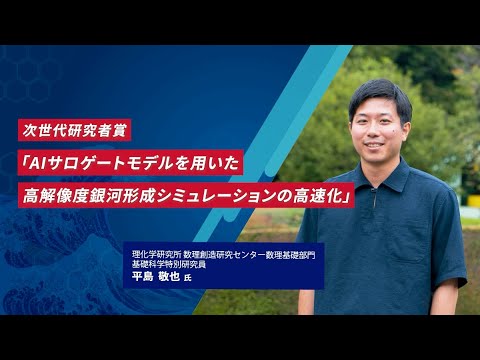
Next-Generation Researcher Award 2024” Commemorative Interview (3): Keiya Hirashima, RIKEN iTHEMS
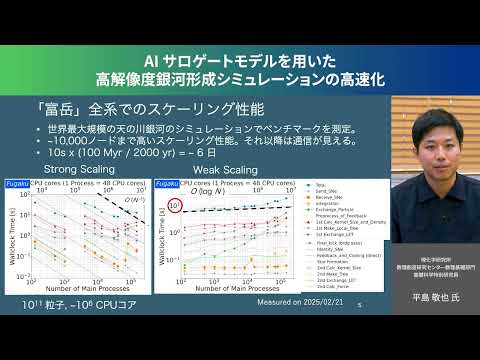
Next-Generation Researcher Award 2024” Commemorative Interview (3): Accelerating High-Resolution Galaxy Formation Simulations Using AI Surrogate Models (Takaya Hirashima, RIKEN iTHEMS)

Physicists’ Dialogue: Discussing Quantum Gravity and Black Holes — PART Ⅱ (in Japanese)
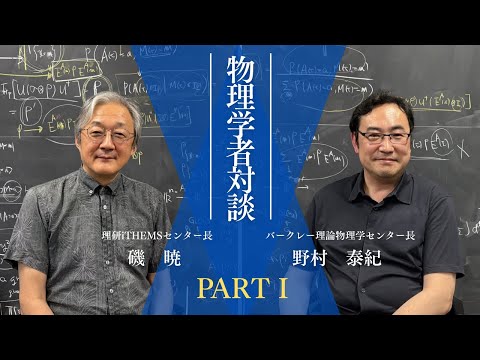
Physicists’ Dialogue: Discussing Quantum Gravity and Black Holes — PART Ⅰ (in Japanese)
Interview with Mathematician Taketo Sano [PART Ⅱ] (in Japanese)
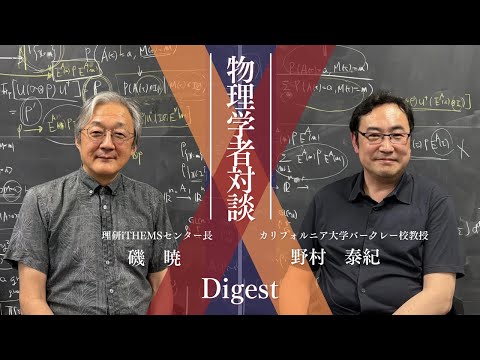
Physicists’ Dialogue: Discussing Quantum Gravity and Black Holes — Digest (in Japanese)
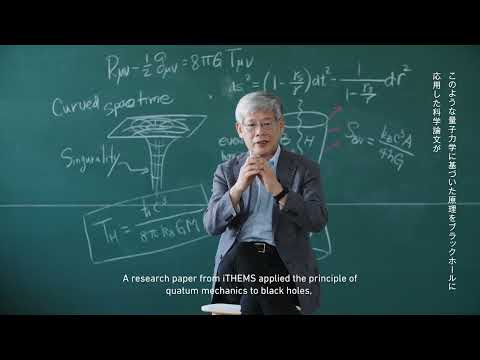
Introduction to “Black Hole Recorder” (in Japanese)

Interview with Mathematician Taketo Sano [PART I]

A Century of Quantum Mechanics

Interview with Mathematician Takashi Tsuboi [Part Ⅱ]

Interview with Physicist Yasunori Nomura - Part Ⅳ

Interview with Physicist Yasunori Nomura - Part Ⅲ

Interview with Mathematician Takashi Tsuboi [Part Ⅰ]

Interview with Mathematician Yuto Moriwaki [Part2]

Interview with Mathematician Yuto Moriwaki [Part 1]

Interview with Mathematician Eiji Inoue [Part 2] (in Japanese)

Interview with Physicist Yasunori Nomura - Part Ⅱ

The Connection Between Mathematics and Microbial Research: From Fisheries Science to the Path of Mathematics

Contributed to the 'One Poster per Household' Project – Like the Ones You See in Science Classrooms

Interview with Dr. Misako Tatsuma, a Planetary Formation Theorist

Interview with Mathematician Eiji Inoue [Part 1]

Interview with Physicist Yasunori Nomura - Part I

Interview with Physicist Ryo Namba [Part 2]

Interview with Physicist Ryo Namba [Part 1]

Interview with Ryosuke Iritani, Mathematical Biologist [Part 1]

Theoretical Physicist Tetsuo Hatsuda Interview Vol.2: About Research and Mathematics

Theoretical Physicist Tetsuo Hatsuda Interview Vol.1: About RIKEN iTHEMS

What about climate change in actuality?
Heun Functions as a Common Language: Black Holes Meet Gauge Theory
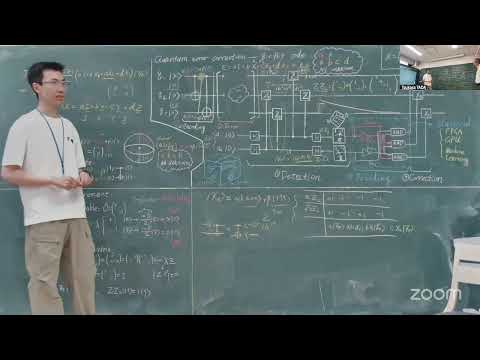
God saves quantum computers by playing dice: introduction to quantum error correction
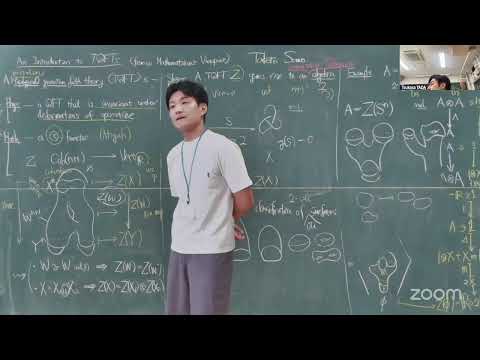
An Introduction to TQFTs (from a Mathematician’s Viewpoint)
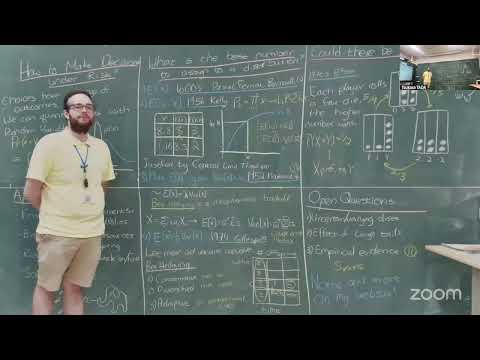
But how many baskets should you put your eggs in?
Spontaneous symmetry breaking
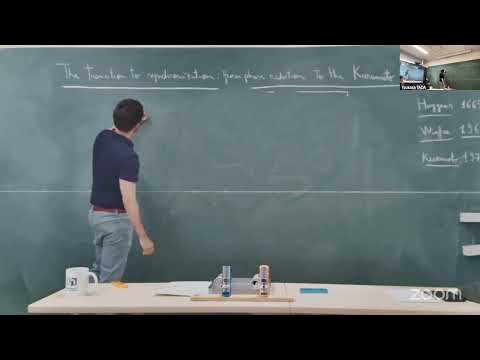
The transition to synchronization: from phase reduction to the Kuramoto model
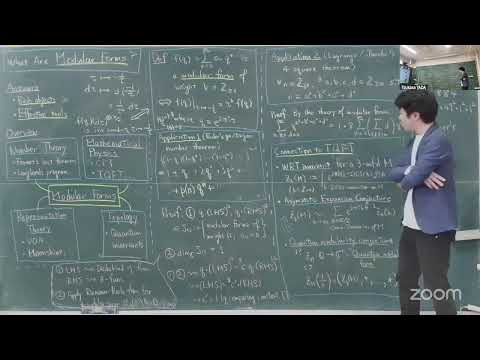
What Are Modular Forms?
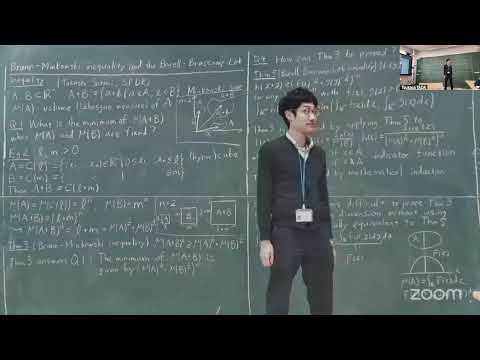
Brunn-Minkowski inequality and the Borell-Brascamp-Lieb inequality
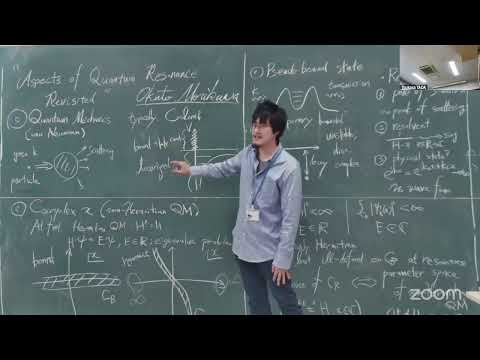
Aspects of Quantum Resonance Revisited
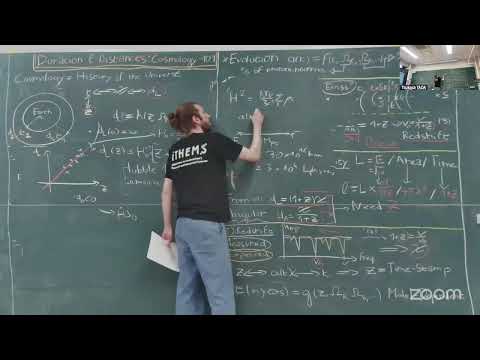
Distances and Durations: Cosmology 101
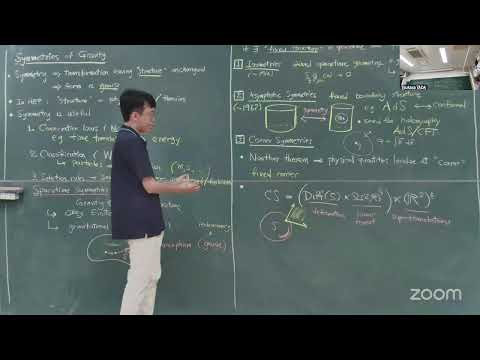
Symmetries of gravity
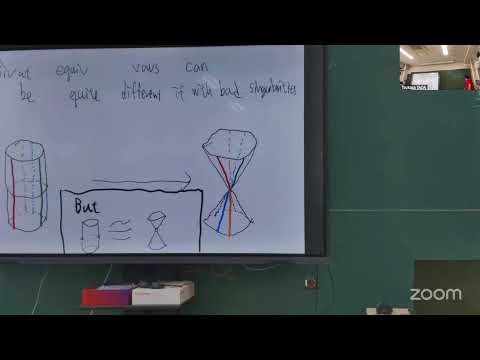
Birational classification of algebraic varieties
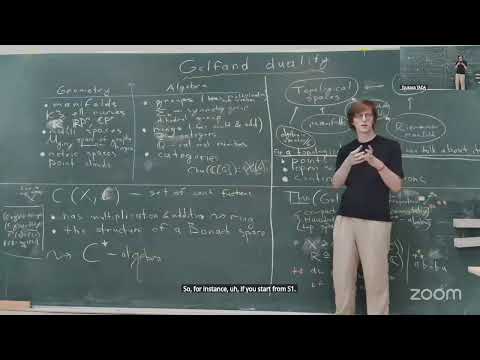
Gelfand duality
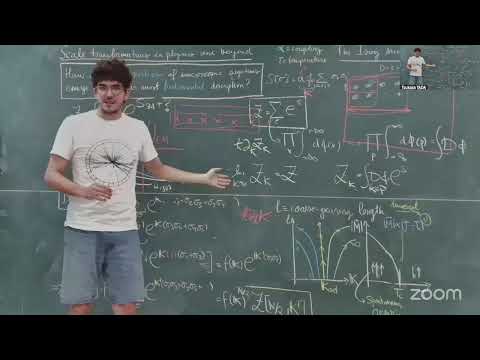
Scale transformations in physics and beyond
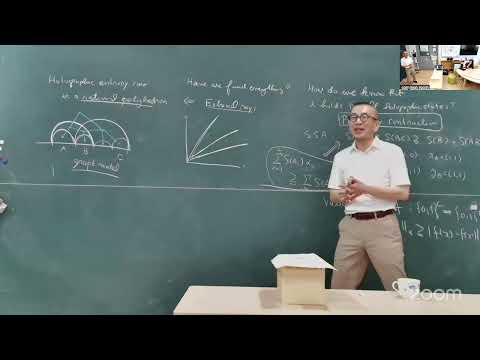
Machine Learning for Holographic Entanglement Inequalities
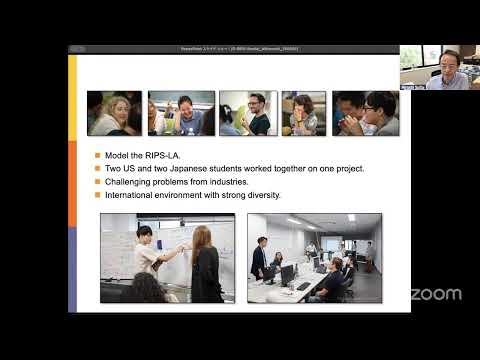
Describing Quantum Phenomena with Classical Gravity

Statistical Signatures of Quantum Chaos in Non-Hermitian Systems

Computers as a Playground for Mathematics

The Free Will Theorem in Quantum Mechanics

Renormalization revisited

Renormalization: Awareness of Ignorance

Recipe for soup of quarks and gluons

A subjective view on what is a quantum effect

Mathematical aspects of the entropic uncertainty relation
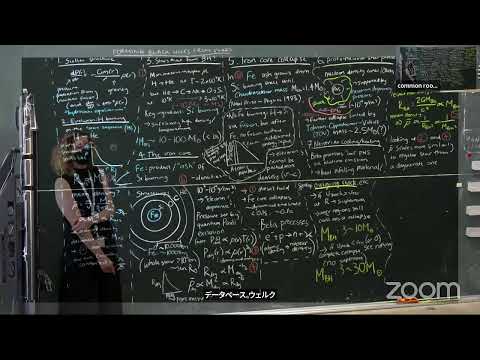
Forming black holes from stars

Singularity Theorems
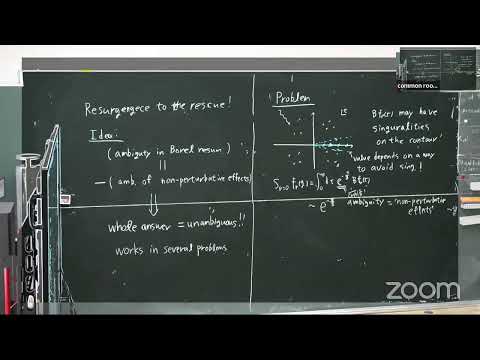
Resurgence: making sense out of non-convergent series
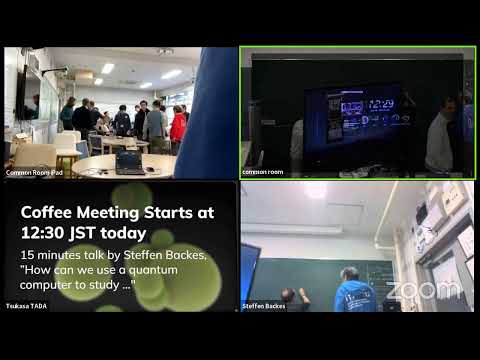
How can we use a quantum computer to study the ground state of the hydrogen molecule?

Applications and Extensions of the Nielsen-Ninomiya Theorem in Condensed Matter Physics

COVID-19: then, now, and into the future

Exploring Quantum Spacetime

Classical simulations of quantum computers
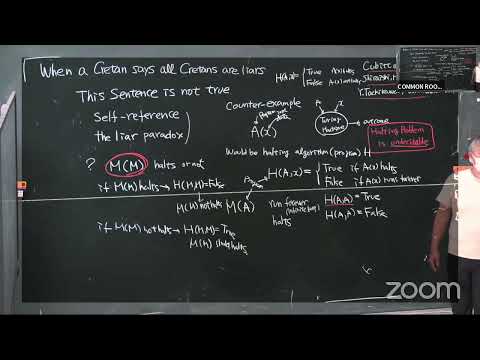
When a Cretan says all Cretans are liars
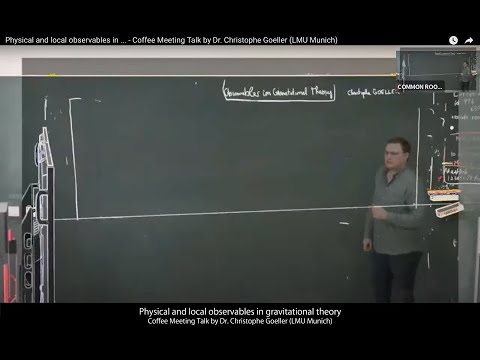
Physical and local observables in gravitational theory
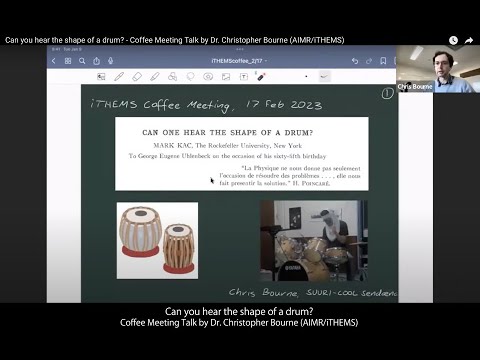
Can you hear the shape of a drum?
Quantum many-body physics with cold atoms
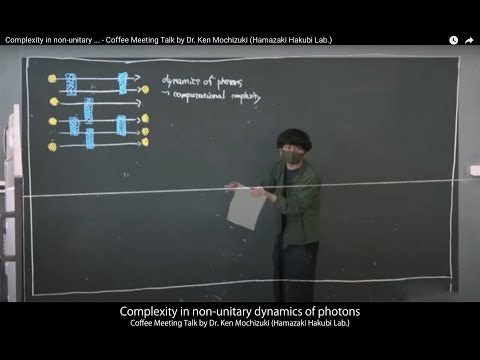
complexity in non-unitary dynamics of photons
Physics Through the Looking Glass

A new B.O.A.T. in astrophysics

Evolution and our daily rhythms

Area law of entanglement entropy in quantum many body systems and its implication in tensor network calculation
Comparison between conventional computers and quantum computers
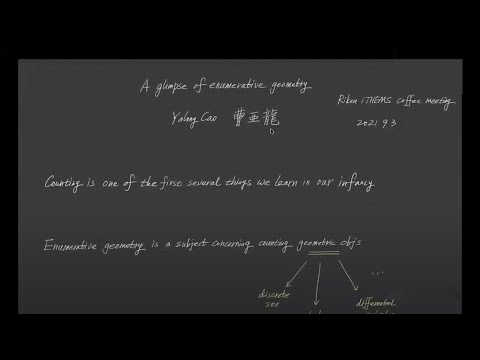
A glimpse of enumerative geometry
Message-passing algorithms for graphical models
Canonical form of tensor networks in one and two dimensions

The basics of topological band theory
Building something from nothing: a mathematical framework for aperiodic/amorphous sets
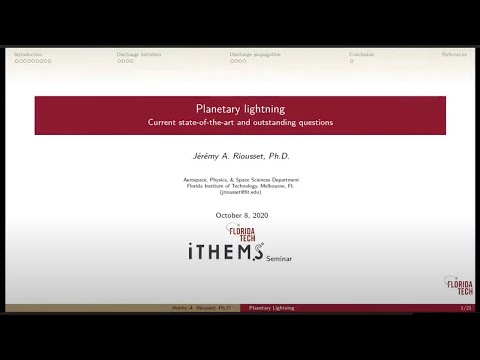
Planetary lightning: Current State-of-the-art and outstanding questions

Collective Power of Science ~ from the High-Energy Atmospheric Physics to our New Exploration of the Universe ~

Morse theory and Floer theory
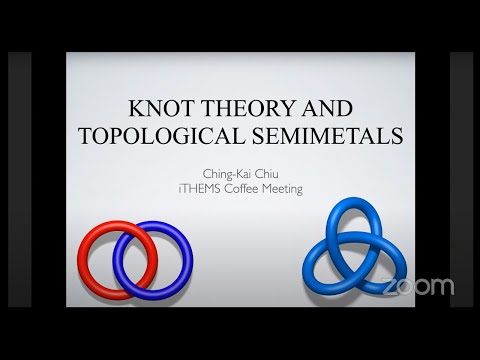
Knot theory and topological semimetals

On Dark Matter

Odd couples of interdisciplinary research

Khovanov homology theory - an introduction to categorification by Dr. Taketo Sano on May 13, 2022

Fundamentals Fest, mini Pre-event on Science "Exploring and Bridging: The Potential of Basic Science"

In Search of Pc pentaquark - Simulate Hadron Interactions with FUGAKU

AAS Journal Author Series: Hirotaka Ito on 2021ApJ…918...59I

Will Useless Knowledge Change the Future? - What is the Black Hole Recorder?

RIKEN 2019 (in Japanese)
RIKEN Center for Interdisciplinary Theoretical and Mathematical Sciences (iTHEMS) is an international research center at RIKEN. It facilitates close collaborations among researchers from different disciplines in theoretical, mathematical and computational sciences. On April 1, 2025, iTHEMS transitioned from a program to a center. The ultimate goal of iTHEMS is to unravel the mystery of the Universe, matter, and life, as well as to solve key problems in modern society through interdisciplinary approaches.

Upcoming Events
-
Seminar
Genome Language Models: From DNA Sequences to Biological Foundation Models
August 13 (Thu) 15:00 - 16:00, 2026
Minrui Chen (Ph.D. Student, Kyushu University)
-
 Colloquium
Hidden Networks: From Phase Reductions to Effective Network Interactions
August 24 (Mon) 15:30 - 17:00, 2026
Christian Bick (Associate Professor, Department of Mathematics, Vrije Universiteit Amsterdam, Netherlands)
-
Lecture
RIKEN–IPMU mini-workshop on QCA and K-theory
August 24 (Mon) - 26 (Wed) 2026
-
 School
AI for Science Summer School
August 25 (Tue) - 27 (Thu) 2026
Masato Taki (Associate Professor, Graduate School of Artificial Intelligence and Science, Rikkyo University)
Lingxiao Wang (Deputy Team Director, AI as Science Team, Division of Applied Mathematical Science, RIKEN Center for Interdisciplinary Theoretical and Mathematical Sciences (iTHEMS))
Vinicius Massami Mikuni (Associate Professor, Kobayashi-Maskawa Institute for the Origin of Particles and the Universe (KMI), Nagoya University)
Naoya Takeishi (Lecturer, The Research Center for Advanced Science and Technology, The University of Tokyo)
Conglong Li (Senior Research Scientist, Google DeepMind, UK)
Akinori Tanaka (Senior Research Scientist, RIKEN Center for Advanced Intelligence Project (AIP)) -
 Seminar
Multistability in Biochemical Reaction Systems: Structural Approach
August 27 (Thu) 16:00 - 17:00, 2026
Takashi Okada (Associate Professor, Program of Mathematical and Life Sciences, Graduate School of Integrated Sciences for Life, Hiroshima University)
-
 Lecture
iTHEMS-UTokyo Intensive Lectures on Quantum Gravity
August 31 (Mon) - September 2 (Wed) 2026
Hikaru Kawai (Visiting Professor, Nambu Yoichiro Institute of Theoretical and Experimental Physics (NITEP), Osaka Metropolitan University)
-
Seminar
Computational demands shape seizure susceptibility in recurrent neural networks
September 3 (Thu) 13:00 - 14:00, 2026
Sebastian Eydam (Research Scientist, Neural Circuits and Computations Unit, RIKEN Center for Brain Science (CBS))
-
 Colloquium
Efficient iBF: Balanced Integration of Fragmented Matching Markets for Welfare Improvement
September 4 (Fri) 15:30 - 17:00, 2026
Fuhito Kojima (Professor, Department of Economics, The University of Tokyo)
-
Lecture
The 11th Intensive Lectures on Quantum Gravity
September 7 (Mon) - 9 (Wed) 2026
Yasuyuki Hatsuda (Associate Professor, Department of Physics, Faculty of Science, Rikkyo University)
-
Seminar
Magic state distillation and cultivation #1
September 10 (Thu) 10:30 - 12:00, 2026
Yutaka Hirano (Research Scientist, Nanofiber Quantum Technologies)
-
Seminar
Magic state distillation and cultivation #2
September 10 (Thu) 13:30 - 17:00, 2026
Yutaka Hirano (Research Scientist, Nanofiber Quantum Technologies)
-
Seminar
Making robust reionisation 21 cm signal predictions with C21LRT
September 11 (Fri) 14:00 - 15:15, 2026
Qin Han (JSPS International Research Fellow, Shibaura Institute of Technology)
-
 Seminar
Primtive form of singularity and mirror symmetry
September 11 (Fri) 15:30 - 17:30, 2026
Zhe Wang (Research Scientist, Division of Fundamental Mathematical Science, RIKEN Center for Interdisciplinary Theoretical and Mathematical Sciences (iTHEMS))
-
Workshop
Workshop on Gestalt
September 24 (Thu) - 30 (Wed) 2026
Ko Aoki (Postdoc, University of Copenhagen, Denmark)
-
Workshop
Quantum Computing for Nuclear Physics (QC-NP 2026)
October 13 (Tue) - 16 (Fri) 2026
-
Workshop
Majorana Modes: Fundamentals, Status & Directions
October 13 (Tue) - 16 (Fri) 2026
-
 Seminar
AI and Scientific Discovery
October 19 (Mon) 14:00 - 15:30, 2026
Joseph Ledsam (Google Health Lead, Japan, Google Japan)
-
 Seminar
A non-negative matrix factorization-based approach to integrating multimodal omics data with automatically tuned hyperparameters
November 16 (Mon) 14:00 - 15:00, 2026
Dorothy Ellis (Postdoctoral Researcher, Laboratory for Integrative Genomics, RIKEN Center for Integrative Medical Sciences (IMS))
-
Workshop
KEK(-iTHEMS) Theory Workshop 2026
November 25 (Wed) - 27 (Fri) 2026
Hirotaka Hayashi (Professor, Department of Physics, School of Science, Tokai University)
Hikaru Kawai (Visiting Professor, Nambu Yoichiro Institute of Theoretical and Experimental Physics (NITEP), Osaka Metropolitan University)
Takato Mori (Ph.D. Student, Department of Particle and Nuclear Physics, School of High Energy Accelerator Science, The Graduate University for Advanced Studies (SOKENDAI))
Masaya Nakagawa (Assistant Professor, Department of Physics, Graduate School of Science, The University of Tokyo)
Masaki Shigemori (Professor, Department of Physics, Graduate School of Science, Nagoya University)
Tadashi Takayanagi (Professor, Yukawa Institute for Theoretical Physics, Kyoto University)
Norihiro Tanahashi (Program-Specific Associate Professor, Department of physics, Graduate School of Science, Kyoto University)
Tatsuya Yamaoka (Ph.D. Student, Department of Physics, Graduate School of Science, The University of Osaka)
Opportunities
-
Seeking a few of Research Scientists or Postdoctoral Researchers (26-714)
Deadline: August 16, 2026
iTHEMS is seeking applications for a small number of Research Scientists or Special Postdoctoral Researchers to conduct research on the mathematical foundations of quantum information.
-
Seeking a few Research Scientists or Postdoctoral Researchers (26-428)
Deadline: Open until filled
Research Scientists or Postdoctoral Researchers, a few positions. We invite applications from researchers who are motivated to advance foundational research in artificial intelligence (AI), particularly deep learning, in order to develop more advanced AI technologies and to pioneer their applications in the natural sciences.
-
RIKEN iTHEMS – NCTS Joint Postdoctoral Position
Deadline: Open until filled
RIKEN Center for Interdisciplinary Theoretical and Mathematical Sciences (iTHEMS) and Taiwan’s National Center for Theoretical Sciences (NCTS) have launched a joint research initiative starting in April 2026 and are now inviting applications for several RIKEN iTHEMS – NCTS Joint Postdoctoral Positions.
-
[Female only] Seeking a few Senior Research Scientists, Research Scientists, Postdoctoral Researchers (26-7)
Deadline: Open until filled
iTHEMS is seeking to recruit a few Senior Research Scientists, Research Scientists, or Postdoctoral Researchers. Details of the job responsibilities and work location will vary depending on the assigned laboratory or research group.
-
Seeking a few Postdoctoral Researchers, Research Scientists or Senior Research Scientists (25-1262)
Deadline: Open until filled
Seeking a few Postdoctoral Researchers, Research Scientists or Senior Research Scientists to conduct research in the Quantum Mathematical Science Team, in collaboration (and, if necessary, jointly appointed) with cooperating laboratories.
Latest News
-
2026-08-07
Featured Paper of the Week
Using chaos and symmetry to bootstrap quantum gravitational wormholes
An international research collaboration between Gabriele Di Ubaldo (RIKEN-Berkeley Center at UC Berkeley and RIKEN iTHEMS), Jan Boruch (University of California, Berkeley, US), Felix M. Haehl (University of Southampton, UK), Eric Perlmutter (Université Paris-Saclay and Institut des Hautes Études Scientifiques, France), and Moshe Rozali (University of British Columbia, Canada) published the new study in Physical Review Letters. Random matrix theory provides a universal description of chaos in quantum systems, capturing statistical patterns among energy levels without requiring knowledge of microscopic details. The new challenge addressed is its extension to 2D Conformal Field Theories and their holographically dual 3D quantum gravity via the AdS₃/CFT₂ correspondence. In the AdS₃/CFT₂ correspondence, quantum gravity in a three-dimensional negatively curved spacetime is encoded in a two-dimensional conformal field theory on its boundary. The key difference is modular invariance, a symmetry stating that a theory on a 2D torus is invariant under modular transformations, which imposes stringent constraints and a rigid mathematical structure, seemingly incompatible with quantum chaos and random matrix theory. Building on the 2023 work of Di Ubaldo and Perlmutter, “AdS₃/RMT₂ duality”, the researchers developed a general, nonperturbative framework called RMT₂ that uplifts the correlations of any random matrix model into fully modular-invariant quantities. The team then used RMT₂ to predict quantum amplitudes for 3D wormholes with multiple torus-shaped boundaries. A wormhole is a tunnel-like geometric connection between otherwise separate regions or boundaries of spacetime. While it is not a shortcut for interstellar travel as in sci-fi movies, it encodes deeply quantum information about gravity and black holes. For the three-boundary wormhole, the team also performed a gravity calculation that agrees with the RMT₂ prediction. By turning the earlier AdS₃/RMT₂ proposal into a general framework, the study advances a research direction that Gabriele helped pioneer and provides a new tool for probing black-hole microstates and, in the near future, solving AdS₃ quantum gravity. For further details, please see the article in Physical Review Letters.
-
2026-08-07
Award
Riccardo Muolo Awarded Third Place at Falling Walls Lab Tokyo 2026
Riccardo Muolo awarded 3rd Place at Falling Walls Lab Tokyo, Japan Riccardo Muolo (Special Postdoctoral Researcher, Division of Fundamental Mathematical Science, iTHEMS) took part in the Falling Walls Lab Tokyo, Japan, held on 28 July 2026 at Shibuya Sakura Stage, and was awarded 3rd Place by the jury. The Falling Walls Lab is an international pitch and science-communication competition hosted by the Falling Walls Foundation, a Berlin-based non-profit founded in 2009 on the twentieth anniversary of the fall of the Berlin Wall. The Foundation channels the spirit of that night to ask a recurring question — which are the next walls to fall in science and society — and works to make breakthrough ideas accessible across borders and disciplines. Open to students and early-career professionals of all disciplines and nationalities, the Lab invites participants to pitch their research, business model, or innovative idea in just three minutes, in front of their peers and a jury from academia and business. Academic institutions around the world are invited to host their own Falling Walls Lab and send their winners to the Falling Walls Lab Finale in Berlin, where the Finalists compete for the title of Breakthrough Winner in the Emerging Talents category and the chance to pitch again on the main stage of the Falling Walls Science Summit. This year’s Tokyo edition was organized by EURAXESS Japan, the German Centre for Research and Innovation (DWIH) Tokyo, and Tobitate! Japan. Riccardo’s research covers nonlinear dynamics on networks and higher-order structures, synchronization, Turing pattern formation, and the control of dynamical systems — exactly the kind of cross-disciplinary work the Falling Walls Lab is designed to showcase. Distilling it into a compelling three-minute pitch and earning recognition among a strong international field of participants is a fine achievement. Congratulations, Riccardo!
-
2026-08-06
Press Release
Discovery of Anomalous Fluctuations and Universality in Atom Detection Counts
Kazuki Yamamoto, Lecturer at the Graduate School of Science, Osaka Metropolitan University, and Ryusuke Hamazaki, RIKEN Hakubi Research Team Leader at the RIKEN Pioneering Research Institute and Senior Research Scientist at the RIKEN Center for Interdisciplinary Theoretical and Mathematical Sciences (iTHEMS), have theoretically demonstrated that the fluctuations in the number of detected atoms in a continuously measured quantum many-body system consisting of a large number of atoms change dramatically depending on the measurement strength. They found that when the measurement is weak, the number of detected atoms exhibits standard fluctuations, whereas when the measurement is strong, unusually large anomalous fluctuations emerge. For more details, please visit the Osaka Metropolitan University website.
Upcoming Visitors
-
Visiting
Yang-Yang Tan
Postdoctoral Researcher, Institute for Physics of Intelligence, Graduate School of Science, The University of TokyoTerm: May 1 (Fri) 2026 - April 30 (Fri) 2027Visiting Place: Main Research Building, RIKEN Wako Campus -
Visiting
Victor Kawasaki-Borruat
Doctoral Student, Doctoral Program in Electrical Engineering, École Polytechnique Fédérale de Lausanne (EPFL), SwitzerlandTerm: August 3 (Mon) - September 4 (Fri) 2026Visiting Place: Main Research Building, RIKEN Wako Campus -
Wakaba Tateishi
Assistant Professor, Hokkaido Musashi Women's UniversityTerm: August 18 (Tue) - 21 (Fri) 2026Visiting Place: Main Research Building, RIKEN Wako Campus -
Bowen Yang
Postdoctoral Fellow, Harvard University, USATerm: August 29 (Sat) - September 11 (Fri) 2026Visiting Place: Main Research Building, RIKEN Wako Campus